
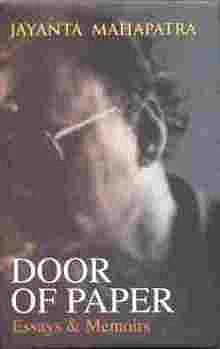
The English-language poet Jayanta Mahapatra did not begin writing poetry until rather late in life, around the age of 40. At that time, English-language poetry in India read very haltingly – more or less like a series of statements. In the hands of the Orissa-born Mahapatra, however, Indian English poetry acquired a deep sense of introspection – an exploration of the self and a new look at the country's cultural context. Mahapatra's poetry did not state, but rather suggested; he was one of the first Indian poets to be able to manipulate the language of the coloniser to suit his own needs. His poetry is now being emulated by a body of young poets from Kerala to the Indian Northeast.
Mahapatra first received recognition abroad. In 1971, editors from the premier British literary journal Critical Quarterly, upon accepting seven of the then unknown poet's works, told Mahapatra that they were publishing poems from an Indian for the first time in the magazine's 15 years of publication. Five years later, in the US, Mahapatra received a major award from Poetry magazine, which was followed by the publication of his collection A Rain of Rites by the University of Georgia Press. That same year, he was invited back to the US to attend the prestigious Iowa International Writing Program. His magnum opus, Relationship, a long poem that deals with the rich cultural heritage of Orissa, was also eventually published in the US in 1980.
Mahapatra has published 16 volumes of poems, but over the past three decades he has also written copious prose pieces. Those works are now collected in the long-awaited Door of Paper. These essays deal with a broad spectrum of themes, from hunger in Orissa, to the creative process, socio-cultural conflicts, his responses to the works of others, and meditations on the poetic use of mystery, silence and time. Whatever his theme, Mahapatra's essays bear the indelible imprint of a poet.
Since that first success in the early 1970s, Mahapatra has regularly published poetry in Western magazines, including the New Yorker, the Sewanee Review and Poetry. But one particular journal, London Magazine, would never touch his poems. His reflection on this in Door of Paper is revealing, as to why and how Mahapatra's poems are the way they are: