
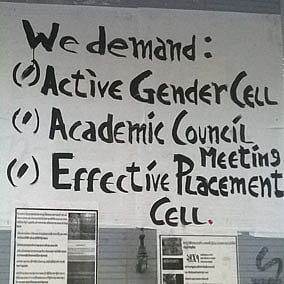
Universities are often seen as relatively safe spaces for students from all genders to interact more freely than they would be able to off campus. Many students get together to imagine a more equal society, one that does not tolerate discrimination, by organising demonstrations, awareness programmes, or social events. But recent cases of sexual violence against women on university campuses have raised questions regarding the safety of the university space, and revealed the pressing need for gender sensitisation through active and efficient gender cells in the form of Gender Sensitisation Committees Against Sexual Harassment (GSCASH).
In recent months, the molestation and rape of female students on the grounds of Jadavpur University (JU) in Kolkata, English and Foreign Languages University (EFLU) in Hyderabad and Jawaharlal Nehru University (JNU) in Delhi have led to student protests demanding better mechanisms to appropriately address such cases at universities. At JU, a female student reported to the university and police that she was assaulted, dragged to the boy's hostel and molested by a group of male students during an annual festival organised by the Arts Faculty Students Union. Her male companion was also beaten up (on 28 August 2014). At EFLU, a female student was reportedly gang-raped in the Men's Hostel after going there to visit a friend (on 31 October 2014). And at JNU, a PhD student reported that she was sexually assaulted by a research scholar and blackmailed to hide the incident (12 November 2014). While these cases are not the first incidents of sexual violence on campus, they have drawn attention to the fact that university administrations are ill-equipped to appropriately address gender violence.
Reactions to each of the cases differed. Jadavpur University launched an internal investigation, but authorities were slow to respond and did not take immediate action against the perpetrators. Instead, female representatives of the university paid the girl an unauthorised visit, and questioned her presence near a boy's hostel on the night of the incident, asking her what she was wearing and whether she was drunk. This violated the Vishaka Guidelines against Sexual Harassment at Workplace, which condemns the use of external pressure on the victim or the accused during the investigation period. The police had started an investigation, but also did not take immediate action based on the victim's identification of the perpetrators.
JU Students were enraged by the university's slow and inappropriate actions and called for a fast-track independent investigative committee that would look into the incident and make its proceedings public. They also staged protests demanding a public statement from the vice chancellor (VC) as to why a proper investigation was not taking place. When the VC ignored the protests, students began to stage an indefinite sit-in in front of his office. In the early hours of 17 September, police and unidentified men in civilian dress forcefully broke up the protests, injuring several students and arresting over 35. Reportedly, few female police officers were present, and students – male and female – were beaten and molested by male officers and the other men in plain clothes. This only enraged students more, leading them to organise further protests to demand the VC's resignation. Eventually, West Bengal Chief Minister Mamata Banerjee visited the JU campus on 12 January 2015 to announce to the students that the VC would resign.