
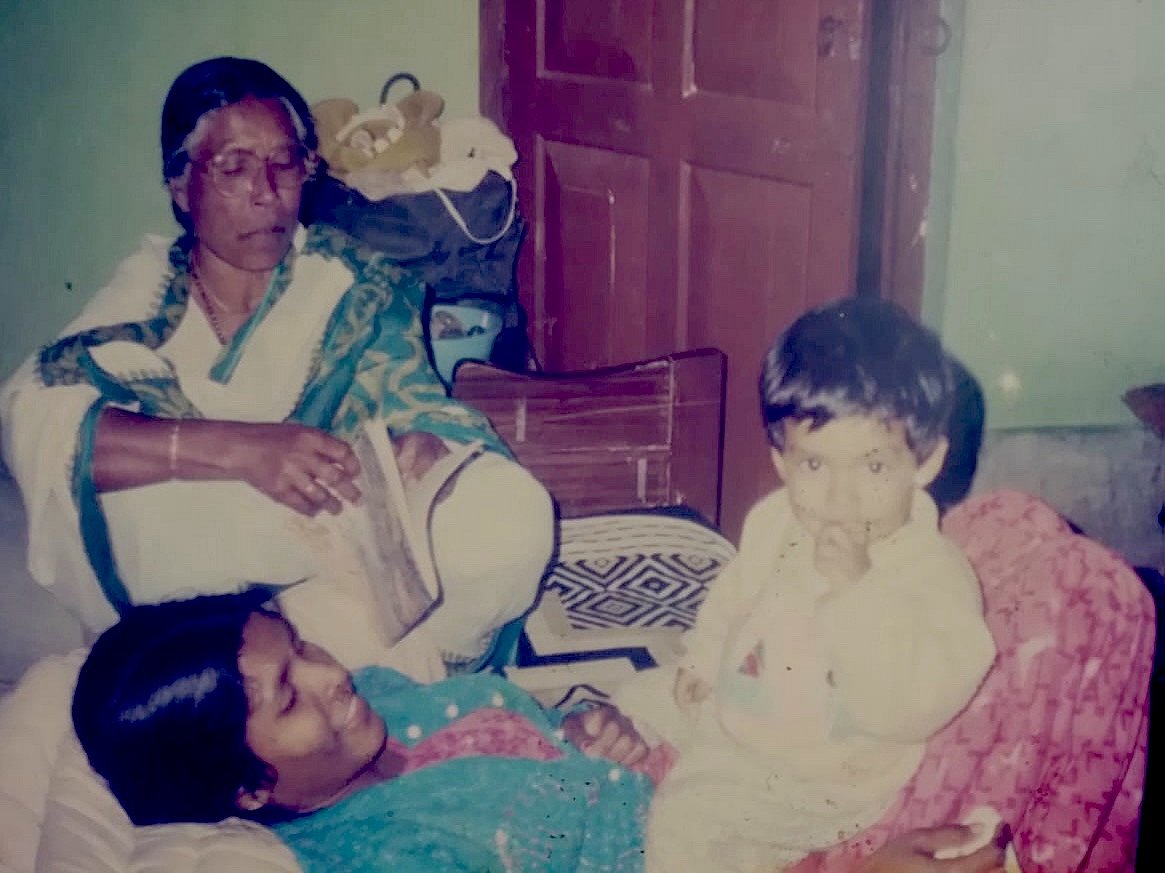
MY GRANDMOTHER died over a decade ago. Every now and then, I am reminded of the tales she used to tell me when I was a child. Many were from the Mahabharata, the Hindu epic that she taught herself to read. She kept her copy in a cloth case, striped yellow, red and blue, on top of an almirah in our railway officer’s housing in Chittagong (now called Chattogram), in south-eastern Bangladesh. It was her belief that one should keep the Mahabharata at the highest place in the room, in recognition of its sanctity.
My “uneducated” but self-taught grandmother taught me how to read the Mahabharata – and the Bhagavad Gita, the philosophical treatise contained within it – as well as the other famous Hindu epic, the Ramayana. To this day, I remember many shlokas, or verses, from these sacred texts, simply because she had me recite them over and over.
My grandmother raised my father, who became a chief engineer of Bangladesh Railway. She used to say that I was destined for great things, partly because I was good at reciting holy texts but mostly because I was the only boy in my family and deemed the “light of the clan.” I was never sure what she meant, and I am more unsure now if I will ever live up to her expectations. She always thought I would be a great religious scholar. I have become a scholar, but a scholar of politics, not religion.. Still, she inspired me to learn my religion.
Inevitably, the contradiction of our caste came up. My family belongs to the Namasudras, a Dalit community, deemed lower than the lowest caste in the Hindu order. The Namasudras were once known by another name: Chandals – a word that stung like a slap when uttered in the wrong tone, in the wrong place. Chandals were the people who cremated the dead. They lived on the margins, geographically, socially and spiritually. In Bengal’s villages, they were forced to live outside the perimeters of the main settlement, near the cremation grounds. They performed the last rites of others but were denied their own dignity. They handled the bodies of the dead but were not allowed to sit among the living. They were the polluters, the untouchables, the remainder of a cruel arithmetic known as varnashrama – the Hindu social and spiritual hierarchy. Religious diktat bound them to this menial duty and denied them education.