
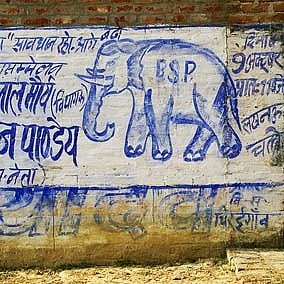
Debates concerning caste-based politics have taken a significant turn in the wake of the decisive electoral victory of the Narendra Modi-led Bharatiya Janata Party (BJP) in May. Caste-based political parties, notably the Samajwadi Party and Bahujan Samaj Party (BSP) in Uttar Pradesh (UP), and the Rashtriya Janata Dal and Janata Dal (United) (JD(U)) in Bihar, experienced an unprecedented electoral defeat at the hands of the 'grand Hindu coalition' forged by the BJP. Given the remarkable electoral routing of parties that once galvanised marginalised populations against upper-caste political domination, a nuanced explanation of how exactly this happened is vital. Indeed, how and in what ways did Dalit, Backward Caste (BC) and middle class interests coincide, and where lies the future of caste politics?
A post mortem
In order to form government in India, a party must gain more than 272 of 545 seats in the Lok Sabha. While the BJP won 282 seats, importantly (and somewhat counter-intuitively), it won 41 of the 84 seats reserved for Dalits, with the party's allies securing an additional ten of these seats. It also won 93 of the total 120 seats from the states of UP and Bihar (and vote shares of 42 and 29 percent respectively), which together form the political reservoir of Dalit and BC politics. In Madhya Pradesh, the BJP took 27 of the 29 seats available, while it did not lose even a single of the total 25 seats in Rajasthan. Together these four states provided the BJP with over 50 percent of its Lok Sabha seats and ensured a single party-led national government – a first since 1984. Other significant electoral successes for the BJP occurred in Maharashtra, Karnataka, Assam, Chhattisgarh, Gujarat, Haryana, Jharkhand, Delhi, Himachal Pradesh and Uttarakhand where it secured 118 seats in total, with an average vote share of 44.4 percent.
In making sense of the massive cross-caste mandate given to the BJP, four explanations have been put forth. First, empiricists point out that it was the dextrous management of social alliances – dividing opposition voters, uniting the BJP's traditional vote base and successfully reaching out to voters outside of the BJP's core demographic – that led to victory. A post-poll survey carried out by the Centre for the Study of Developing Societies reveals that: (a) the traditional vote bank of the BJP – the upper castes and trading communities – voted almost en-block for the party; (b) the BJP was able to attract a significant number of non-traditional supporters, including BCs, especially in the critical states of UP and Bihar; (c) one in every four Dalits voted for the BJP; and (d) Muslim votes were made almost redundant because either their vote was divided between 'secular' parties, or, alternately, the addition of their numerical strength to the most viable non-BJP party was insufficient for electoral success under the first-past-the-post system. This was exacerbated by the fact that in the game-changing states of UP and Bihar a critical number of Dalits deserted parties such as the BSP and JD(U), while in most other states they shifted their allegiance from Congress to the BJP or a regional party, many of which were in alliance with the BJP. Finally, the BJP skilfully stitched together pre-poll alliances with Dalit and BC parties in Bihar and Maharashtra that translated into critical additions to their existing support base.
Second, many argue that Modi successfully converted the election into a referendum on his model of development by showcasing Gujarat, the state where he was chief minister for three consecutive terms, and its 'impressive' economic record. During the campaign Modi proclaimed, "Gujarat is showing the country what is possible, and once we walk this path it is irreversible. The result is inclusion, happiness and people empowered to reach their potential." Counterarguments outlining the fallacies of Gujarat's 'development' model in statistical terms – whether by activists, opposition parties or even respected intellectuals like Jean Drèze – failed to dissuade voters from electing the BJP.