
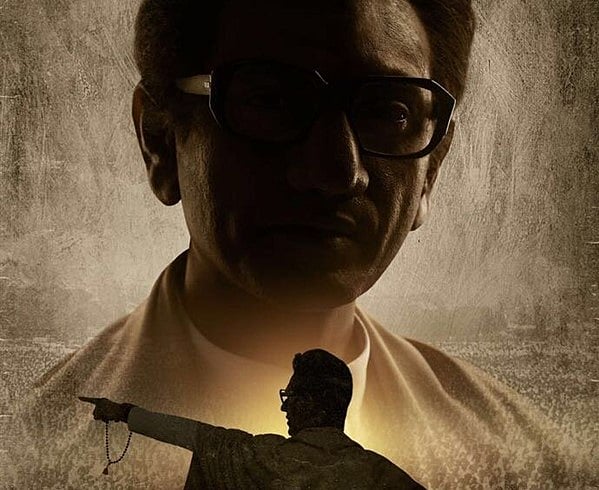
Released in January 2019, Thackeray – a biopic on Bal Keshav Thackeray, founder of the Marathi nationalist party Shiv Sena – is a celebration, rather than a critical take, of the chauvinist politics of the party and its founder. Played by Nawazuddin Siddiqui, Thackeray, emerges in the film as a heroic figure, making the film an effective propaganda that brazenly justifies the violence, hate and bigotry that his politics came to represent.
Starting in the 1950s, the erstwhile Bombay State – which included large parts of present-day Gujarat – saw a number of struggles for the creation of a state for Marathi-speaking people. Following the passage of the 1956 States Reorganisation Act, which enabled the formation of states along linguistic identities, Bombay State was divided into Gujarat and Maharashtra in 1960. In the process, Marathi-speaking areas of erstwhile Hyderabad State were joined with Maharashtra. Bombay city's cosmopolitanism was, therefore, always built on the presence of Gujarati merchants, migrants from southern India – large sections of whom were involved in white-collar jobs – and the majority Marathi-speaking locals. Named after the 17th-century founder of the Maratha empire – its name translates to Shivaji's Army – Shiv Sena promoted a 'son of the soil' Marathi nationalism since its inception in 1966, advocating for the preferential treatment of Marathi-speaking people and opposing non-Marathi speakers living in the state – first those from southern India, and in later years, those from northern India.
Beginning with a courtroom scene, where everyone from the judges to saffron-flag-bearing supporters are in complete awe of Bal Thackeray – who stands charged of inciting violence during the 1992 Bombay riots – Thackeray transports viewers back to the Bombay of the 1960s, where a young Thackeray works as a political cartoonist. As his life unfolds, we see the film, directed by Abhijit Panse – also a leader of the Maharashtra Navnirman Sena, an offshoot of the Shiv Sena – endorse the bigotry and resentment that drove Thackeray's politics.
It soon becomes clear, however, that even as a work of political hagiography, Panse's film is not about faithfully charting its subject's life, but more interested in creating a caricature. For instance, in what is shown to be a landmark point in Thackeray's political life, after just one feud with his boss at the Free Press Journal – a man from southern India who is portrayed as a spineless and unethical professional – Thackeray suddenly quits the job, with an instantaneously produced cartoon passing for the resignation. Thackeray then strolls aimlessly on the streets of Bombay, nonchalantly entering a cinema hall. The hall shows an animation film about the ill treatment of the humble, poor Marathi man in his own land, as the audience of South Indians, Gujaratis and Parsis laughs away. Thackeray sees all this, and realising the distress of the common Marathi man, the movie tells us, a leader is born. In an attempt to create a simplistic narrative of Thackeray's life, the movie, however, ignores details like how the real Thackeray's resignation from the Journal was not quite impromptu. Along with a handful of other staff, he left to start a short-lived paper, before moving on to found the successful Marathi-language weekly Marmik.