
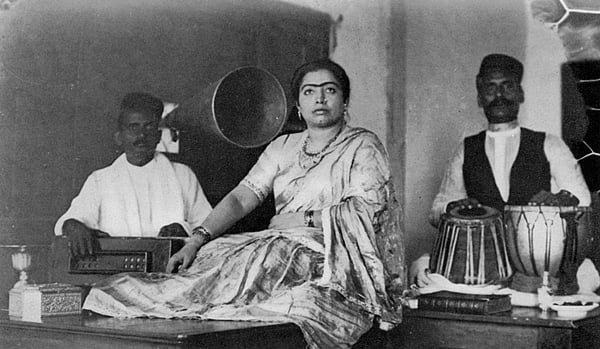
She was the stuff of fairy tales: a flamboyant singer much sought after by British India's nobility; a socialite who threw lavish parties; a hedonist who went about town in expensive horse buggies; a model whose image appeared on matchboxes made in Austria. And then, the inevitable end for someone leading a life as feisty as this: self-destruction, penury and a lonely death. She was Gauhar Jaan – the Subcontinent's first musician to record commercially on the gramophone when the technology came calling in 1902. Despite the cult status she achieved in her lifetime, she is a forgotten figure in the world of Indian classical music, and roams the annals of Hindustani music as a barely discernible ghost. She does have a few admirers though – old-timers and record collectors who treasure her shellac discs and speak about her heyday in superlative terms. But none of this is commensurate either with her pioneering contribution to the world of Hindustani classical music or with the dramatic life she led.
Gauhar Jaan entered my life in the most serendipitous way. It was while sifting through the musty yet meticulously catalogued archives at the Palace of Mysore when researching my first book, Splendours of Royal Mysore: the Untold Story of the Wodeyars, that Gauhar Jaan first caught my attention. The name had a certain ring to it that led me to peruse the box-file containing the exchange of letters from her short stay in Mysore. But the canvas of my project at the time was larger, involving painting a picture of about 600 years of a state's history, with myriad men and women sharing the honours. I really did not have the resources, nor did I feel the need, to dig deeper into the life of this visiting woman musician who spent barely two years in Mysore. But somehow I felt I had found familiar terrain, and she remained on my mind for a long time thereafter.
It was intriguing that a star like Gauhar had had to leave her home town of Kolkata and come to distant Mysore, where she died under pitiable conditions. Her letters portrayed an image of a frustrated diva in the sunset of her life bargaining for extra pay or a merciful act by the Maharaja's Government. All good biographies begin as a love affair or an instance of 'transference', and my work on Gauhar did too. But I was entering an unknown and dark tunnel, given the difficulties of exploring the world of tawaifs and nautch girls who existed mostly in the romanticised accounts of colonial writers and were viewed retrospectively with much nostalgia. To make matters more complicated, Gauhar Jaan had died more than 82 years ago, in 1930, and had no legal heirs, no family members or friends who were alive and who could be spoken to. But it was this aura of mystery surrounding her that made my exploration of Gauhar Jaan's life so exciting. And where better to start than the beginning.
Chaggan's Jaan
Gauhar Jaan was born on 26 June 1873 as Eileen Angelina Yeoward, an Armenian Christian in Azamgarh in present-day Uttar Pradesh. By sheer coincidence I happened to meet someone whose ancestors were pastors in the Holy Trinity Church in Allahabad, where she was baptized in 1875. Fortunately, the church registers were maintained from the 1850s onward, and so I found my first documentary proof of Gauhar Jaan – an account of her baptism, with the names of her parents and grandparents and other witnesses to the ceremony.