
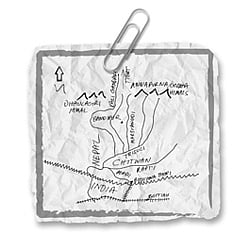
Come with me early this upcoming winter for a trip through backwater history, across borders and ecological zones, across fields, rivers, forests, gorges – and to confront the invasion of modern reality every step of the way. The trip I propose* starts in West Champaran district of Bihar, moving northward through the Chitwan jungle into the central Nepal midhills.
The British built one continuous railway line from Siliguri in North Bengal to Agra-on-Jamuna, hugging the Nepal frontier much of the way, taking in Kishanganj, Darbanga, Sitamari, Motihari, Bettiah, Gorakhpur, Balrampur and Shajahanpur. In childhood, I remember alighting with my family at the station of Dang in North Bihar, crossing the border to visit my maternal home in the village of Sisaut. My maternal ancestors had been exiled by the Kathmandu court, which is how hill Bahuns had found themselves in this corner of dehaat.
It is this memory of the choti line, the lazy khatak-khatak of small wheels on ancient rails, the open windows and the sheer 'rurality' of the passengers that now makes me want to train westward from Raxaul. Much of the meter gauge in this serpentine Siliguri-Agra line – run by the North-Eastern Railway component of the behemoth Indian Railways – is now giving way to broad gauge. But this section in Bihar has yet to convert. Near Raxaul is the small station of Sugauli, which also marks the place where the treaty of 1816 was signed between the Kathmandu durbar and the Company Bahadur. According to my childhood reading there used to be a pillar commemorating the event, but I could not find it the last time I passed through Champaran. (For more on West Champaran, see the article in this issue by Abhay Mohan Jha of Bettiah.)
All of the hill trails of the central Nepal hills, as well as the paths coming down from Tibet's Changtang plateau, down past the principality of Lo Manthang, follow river valleys to end up at the mercantile hilltop township of Bandipur. In 1973, Bandipur was bypassed by the Kathmandu-Pokhara highway, which took the low road, and the district headquarters too was shifted down-valley to Damauli. This was fortunate, in retrospect, because Bandipur's old-world Newar streetscape was preserved. The rock-slab pavements are intact, and the town has suddenly evolved into a tourist destination. Perched high above the Marsyangdi River, this lion-king settlement gives you a 300 km Himalayan panorama to the north, including the nearby ranges of Ganesh Himal, Gorkha Himal, the Annapurnas and Dhaulagiri.