
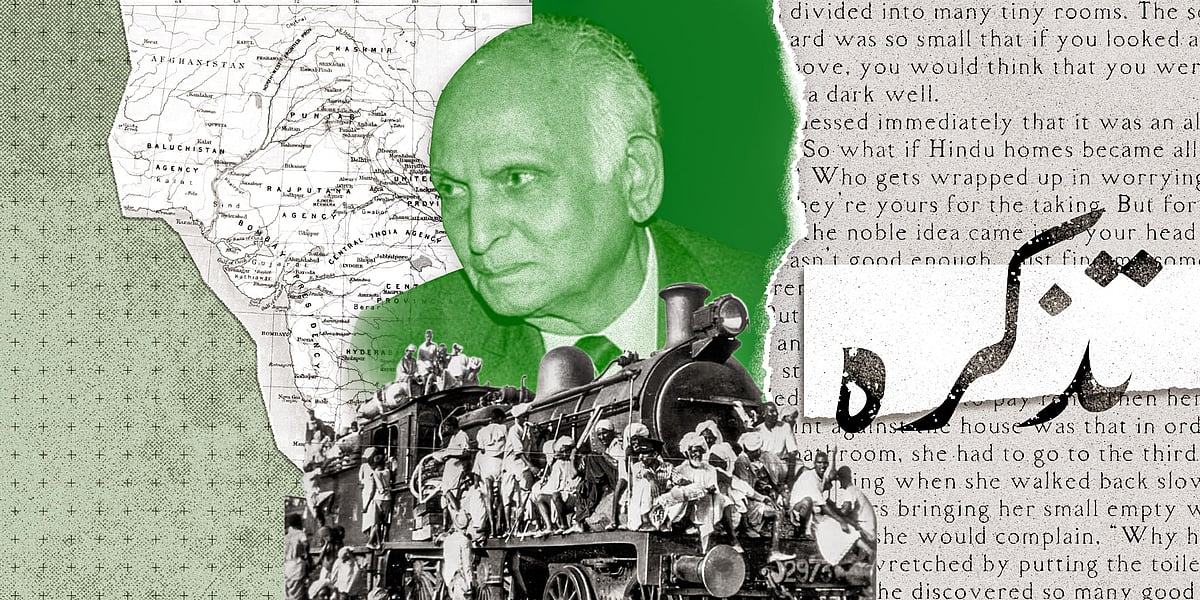
For Urdu novelist Intizar Husain (1925 – 2016), Islamic culture was not monolithic. "What a purely Islamic culture would be, I don't have any idea", he remarked in an interview, "It is this Indian Muslim culture of which I am a product and which has shaped the history of which I am a part". Born in the former United Provinces (present-day Uttar Pradesh), Husain studied Urdu literature at Meerut College and moved to Lahore in 1947 to edit Nizam, the official publication of the Progressive Writers' Movement (a literary organisation founded in the mid-1930s). Husain's decision to migrate to Pakistan was not conscious; rather, it was an impulsive act borne out of a need for work and a desire to be part of Lahore's flourishing literary culture. At the time, he was unaware that a return to his hometown would be impossible.
Husain's sequence of novels – he insisted they were not a trilogy – deal with various periods of turmoil in the history of Pakistan. The first novel, Basti (1979), is a portrayal of post-Partition reality against the backdrop of the 1971 War of Independence; The Chronicle (1987) is set during General Zia-ul-Haq's rule between 1978 and 1988; the third novel, The Sea Lies Ahead (1995), deals with the situation of muhajirs (Muslims who migrated from India to Pakistan after Partition) in the late 1980s and early 1990s, a period characterised by increased ethnic conflict and religious extremism.
While Basti was translated into English in 1995 and The Sea Lies Ahead in 2015, The Chronicle only appeared in English translation in November 2019. The Chronicle – like the other two in the 'series' – is written in Husain's characteristically non-linear style. Weaving together the past and present, he intermixes the protagonist Ikhlaq's postcolonial Lahore with his grandfather Mushtaq Ali's undivided India. In the original Urdu title, Naya Ghar: Tazkirah (The New House: The Chronicle), the word tazkirah – a genre of writing found in Urdu, Persian, and Arabic literature that involves literary record in the form of a commentary or biographical notes – refers to Ikhlaq's family tradition of writing a chronicle.
Indeed, the novel opens with Mushtaq Ali's chronicle and demonstrates Husain's interest in periods of political uncertainty. The Ottoman Empire has ended, the Khilafat movement – a short-lived political campaign launched in India in support of the caliphate – has collapsed, and sectarian divisions have increased ("They were the signs of the end of times"). A character named Mamdoo sees what he thinks is the Beast of the Earth, a sign in Islamic eschatology portending that the Day of Judgment is near; Mushtaq Ali is relieved to find that people do not have a mark on their foreheads. For his friend, Pandit Ganga Dutt, this is the Kali Yuga, a period of destruction. When Mushtaq Ali wonders why family members in the Mahabharata fight one another, the Pandit cites a character in the epic: "there are times when the wise turn to fools, and then there's no stopping anything" – foretelling the communal violence that would ensue after Partition.