
In 2006, Britain's Home Office reported that 8.7 percent of residents of England and Wales used cannabis. This is an unexpected downward trend; in 2004, when the penalty for possession of cannabis was reduced from five to two years in jail, most believed that consumption would increase. (In 2009, the penalty reverted to five years.) Nevertheless, cannabis remains the most popular illicit drug in England and Wales, mostly used recreationally, though its medicinal use is rising. After a century of research aimed at discovering the drug's dangers, the British Medical Association described it as 'remarkably safe … with a side effects profile superior to many conventional medications'.
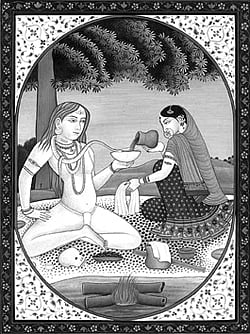
Three centuries ago, the British only knew of the related industrial hemp, cultivated to make cordage, clothing and paper. Today, over 30 countries, including Great Britain, grow hemp for these purposes but also to manufacture biodegradable plastics and biofuels. The British encountered cannabis, or rather bhang, during their initial interaction with the Subcontinent in the 17th century. Sailors, soldiers and merchants no doubt witnessed the sacred as well as recreational use of bhang – smoked by swamis in a chillum, inhaled from a hookah, or mixed in thandai, a drink prepared with almonds, milk, sugar and spices during Holi. Perhaps they also witnessed its therapeutic use in curing fever, dysentery, gonorrhoea and, purportedly, even lisping.
The Oxford English Dictionary indicates that bhang was first mentioned in English in Robert Burton's The Anatomy of Melancholy (1621): 'Another [herb] called Bange, like in effect to Opium'. In fact, however, this reference was lifted from another book – in all probability the first European book printed in India – called Colloquies on the Simples and Drugs of India (1563) by Garcia da Orto, a Portuguese doctor practicing in Goa. The Portuguese, leading in the colonial scramble, had already stumbled upon bhang.
Thomas Bowrey's A Geographical Account of Countries Round the Bay of Bengal 1669 to 1679, written in the 1670s but not published until 1905, provides the earliest record in English of the recreational use of cannabis. The incident occurred in Bengal and involved Bowrey, a merchant seaman, and a handful of his kind. He writes of the preparation: 'Sometimes they mix it with their tobacco and smoke it, a very speedy way to be besotted; at other times they chew it.' But he advises that 'the most pleasant way of taking it is [to] Pound a handful of the seed and leaf together, which mixt with one pint of fresh water, and let it soak one quarter of an hour, then strained through a piece of calico, and drink off the liquor and in less than half an hour its Operation will shew itself for the space of four or five hours.'