
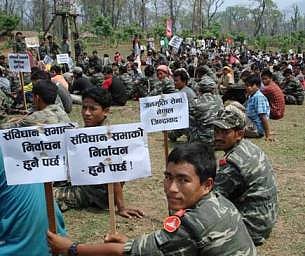
The past month has seen a charade played by the political parties in Kathmandu, including the Communist Party of Nepal (Maoist), newly inducted into the government and interim parliament. Everyone knows that the promised elections to the Constituent Assembly cannot be held in June as planned. And yet everyone is comfortable living the lie that they will be held as scheduled. In fact, all sides vociferously hold forth on the necessity of this, all the while hoping desperately that someone else will make the inevitable announcement. A political calamity is predicted upon the failure to hold the polls in June, and no one wants to be seen to have contributed to this through the act of questioning the dates.
An election to a Constituent Assembly (CA), which would restructure state-society relations, was exactly what the Maoists needed to extract from the parliamentary political parties before they could justify giving up their decade-long 'people's war'. For their part, the parties could not agree to a Constituent Assembly until the Maoists convinced them of their intention to lay down the gun. Agreement was reached on these matters in the so-called 'Twelve-Point Agreement', signed between the two sides after half-secret talks in New Delhi in November 2005. That agreement paved the way for the People's Movement of April 2006, and since then the torturous series of negotiations that saw the adoption of a Comprehensive Peace Agreement, the arrival of United Nations monitors, and the induction of the Maoists into the interim parliament and government. All of these are seen as way-stations on the road to the Constituent Assembly.
Today, the demand for a Constituent Assembly is much more than a means to bring the Maoists in from the jungle. In a country of minorities, all oppressed communities – by ethnicity, language, faith, region and even altitude – have internalised the fact that the state needs to be restructured through the Constituent Assembly. The CA is seen as a means to correct historical neglect and injustice, to overturn the control exercised by Kathmandu Valley by pushing through a federal structure, and – something the political class seems to greatly favour – getting rid of monarchy in all forms and configurations.
In the second week of April, it was left to the Election Commission to ask for 110 days to organise the polls after election laws were enacted, and the commissioners did everything but say out loud that elections were impossible in June. Crucial pieces of electoral legislation were still pending with the government and parliament, the logistics were not in place, and a state of fear and intimidation still prevailed in large parts of a country coming out of a decade-long internal conflict. The United Nations representative in Kathmandu let it be known that June elections were neither politically nor technically feasible.