
Indian universities, over the past several weeks, have become the dedicated laboratory space for testing the limits of a chhappan-inch variety of jingoism. That the university should be targeted isn't particularly surprising – since it was increasingly evident from electoral patterns that the voice of a formidable political opposition (both numerically and principally) was no longer to be found in the houses of the Parliament. The university has been among the last few surviving spaces which continues to evolve a dissensual conscience, however enfeebled by administrative diktats and assaults on academic autonomy. The routine installation of puppets of the establishment, such as Gajendra Chauhan in Film and Television Institute of India, Pune and Sudershan Rao at the Indian Council of Historical Research, seemed to have only strengthened resistance and solidarity between and beyond the otherwise-ghettoised citadels of knowledge-professionals.
The organised witch-hunt of individuals and clampdown on spaces of dissent in the past two years came to a head at Hyderabad Central University with the institutional murder of Dalit scholar Rohith Vemula on 17 January 2016. A frenzied attempt to hush up the role of the government in the case gave birth to a sensational media-trial surrounding anti-national slogans in Jawaharlal Nehru University. The 'traumatic wound' of the slogan was opened up and then sought to be immunized with home-made concoctions of medicinal value – namely, that of 'nationalism'. State-mandated first-aid doles included the measured flutter of the national flag on university campuses and the suggested display of army tanks within the university in close proximity to academic blocks. To exorcise the 'seditious' germ from the body of the university, the ruling party has alternated between the tactical and the antic – alongside threats of withdrawing grants and fellowships for research, we have now seen a numerical calibration of anti-national morality in the alleged numbers of condoms and meat bones found within the campus.
I shall not enter into the content of the 'wounding' slogan, since there is no need for a consensus on what constitutes offence. I shall also not decry the alleged content of the offending speech (reconstructed severally from hearsay reports and circumstantial records), nor speculate about the source of the said utterance attributed to imagined Kashmiri separatists or real ABVP conspirators. The legal history of court judgments on sedition has also been adequately talked about, as has the tenuous evidence against arrested students. That the case will not stand up to judicial scrutiny is known to most of us; and we also know that the government is well aware of it. Why then are they continuing to hound students such as Kanhaiya Kumar, Umar Khalid, Anirban Bhattacharya and Ashutosh Kumar? There may be a clue in the Patiala House Court violence that unfolded on 15 February 2016, in which a group of lawyers beat up journalists, students and teachers at the time Kanhaiya Kumar was to be presented before the magistrate. Such spectacles of Sangh-backed lumpenism send out a message to a larger public; it is a signifier of an order of impunity that one must not dare to challenge. The spaces of mobilisation and dissent that the newly-initiated student walks into – while behaviourally governed by the parents' injunction to 'study' and 'not do politics' – are now in danger of being erased under the weight of direct state surveillance and the immanent possibility of police action.
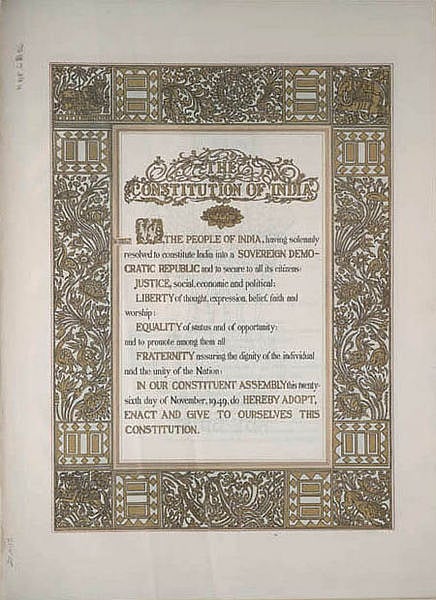
My first question concerns the polemical force of the 'anti-national' and its relationship with the Constitution of India. Notwithstanding debates about the correctness of the slogan uttered in JNU or the 'martyrdom' of Afzal Guru, a question arises: is the Indian Constitution, as establishing the rule of law, the guarantor of nationalism? More pointedly, is the 'anti-national' a constitutional category? And if it is not, must we lend the term scholarly credence by launching into a defensive mode about the content of the purportedly 'criminal' slogan? Is dissent guaranteed by the Constitution only when the substantive content of utterance is sanctioned by the ideology of a 'government established by law'? Can an assertion of the constitutional right to self-determination – solely as response to historical injustices and military atrocities perpetrated by successive governments – be legitimate grounds for a 'reasonable restriction' on free speech?