
Two cabinet ministers flanked Sri Lankan President Mahinda Rajapakse when he met visiting Indian Foreign Minister Pranab Mukherjee in mid-January. One was Mukherjee's counterpart Mangala Samaraweera. The other was Minister for Science and Technology Tissa Vitharana. The latter was present not in his ministerial capacity but in his new avatar as chairman of an all-party forum convened by Rajapakse to formulate proposals for constitutional reform.
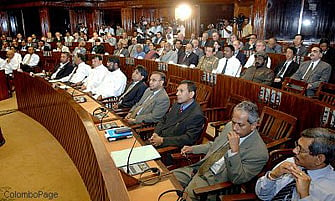
| Caption: The APRC mulls the options. |
Vitharana's role in the meeting was to explain in depth the recent progress made by Sri Lanka in the sphere of constitutional reform. New Delhi had been exerting pressure on Colombo to evolve a political consensus on such reform among political parties represented in Parliament. This consensus was to include agreement on a scheme of devolution aimed at resolving the Tamil national question. Vitharana, a leader of Sri Lanka's Trotskyite Lanka Sama Samaja Party (LSSP), had played a prominent role in the search for greater devolution, and there could not have been a better man to hold forth on the subject for India's benefit.