
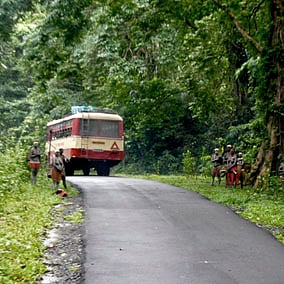
To the north of Port Blair, if one follows the Andaman Trunk road away from the sea and along the treeless countryside, modern civilisation as we know it comes to a halt. The road sees you through iron gangplanks and hillocks of half-abandoned houses, as the landscape first gives into marsh land, and then into tall trees in the far sight. As Murugan would tell his bus passengers later, the next 50 kilometres of the passage went through rainforests belonging to one of the world's most endangered groups, the indigenous Jarawa. It was 16 years ago, in 1998, when the Jarawas first made the choice to abandon arms against mainstream entrants into their reserve. Driving through these forests, Murugan said raising his chin, had always been one of the more dangerous jobs in the history of the Andaman Islands.
Every morning at 6 am, the gates to the Jarawa Tribal Reserve, located in the Middle Straits of the Andamans, are thrown open with a loud pre-recorded voice reading out instructions of social conduct to be followed inside the forests. Following this, a convoy of cars and buses cross into the forests from the hamlet of Jirkatang, the last housing settlement towards Baratang Island, a less popular attraction for tourists. En route the convoy crosses another that approaches Jirkatang from Baratang. Throughout the day, six more convoys enter the reservation from either side at three hour intervals.
Before entering the reservation, Murugan takes out a court order to frighten the passengers into burying deep their camera equipment. In 2012, one of these tourists was British journalist Gethin Chamberlain of the Observer, who exposed these excursions inside the reservation and the role of the police in facilitating them. When the Supreme Court ordered the Trunk Road to be permanently shut down in January 2013 – effectively banning what turned out to be oppressive occurrences of human safaris – both tour operator friends of Murugan and tribal-rights activists believed that this was the end of the safaris and the tribe's claim to their land had finally been granted. To the former's delight and the latter's despair, just over a month later the Supreme Court removed the ban, putting the likes of Murugan back in business.
From past to present
In the beginning of the 18th century, the Jarawas inhabited the South Andamans while being at war with the Aka-Bea-da tribe. The Jangils, who bore some relation to the Jarawa, were situated further south on Rutland Island. The first colonisers of the land, the British East India Company, built their townships around Chatham and Ross Island, cleared the forests starting with southeast Andamans and managed to push the tribal demographic towards the north. They frequently attempted to make contact and engaged in the practice of 'gift-giving' with Jarawas, efforts which were sometimes reciprocated with hostility. As the number of colonial villages and forestry expeditions increased, small battles between the tribe and the police or bandits became common. While the other two tribes perished into extinction, the Jarawas survived the exodus. In 1957, their habitation area from the southwestern forests of Constance Bay through the Middle Straits into the Middle Andamans and the marina around it was declared a tribal reserve under the Andaman and Nicobar (Protection of Aboriginal Tribes) Regulation Act, 1956.