
The year 1982 was an exciting one for Indian people. The radio and the newspapers were full of news of the Asian Games in New Delhi. Coins featuring Appu, the dancing elephant and mascot of the Games, and the Jantar Mantar in Delhi, about which many of us learnt for the first time, were already in circulation months before the opening ceremony. Newspapers told us that thousands of trees were felled in Delhi to broaden the streets, and that the price of tomatoes there was only INR 2 per kilogram due to the heavy influx of vegetables in preparation for the event. News of the construction of Appu Ghar, India's first amusement park, got kids thrilled beyond belief.
1982 was also the year in which Doordarshan (DD), then the sole television broadcaster in India, started broadcasting its programmes nationally. And with this, television came to Guwahati, the state capital of Assam. The advent of television brought unbelievable excitement. For those with relatives in Guhawati affluent enough to afford a television set, it was customary to explain in great detail to the rest of us how a TV worked and how exciting it was to watch TV programmmes. Most of us developed an inferiority complex, and with extreme jealousy we cursed ourselves for living in such a small town where we were deprived of television's wonders.
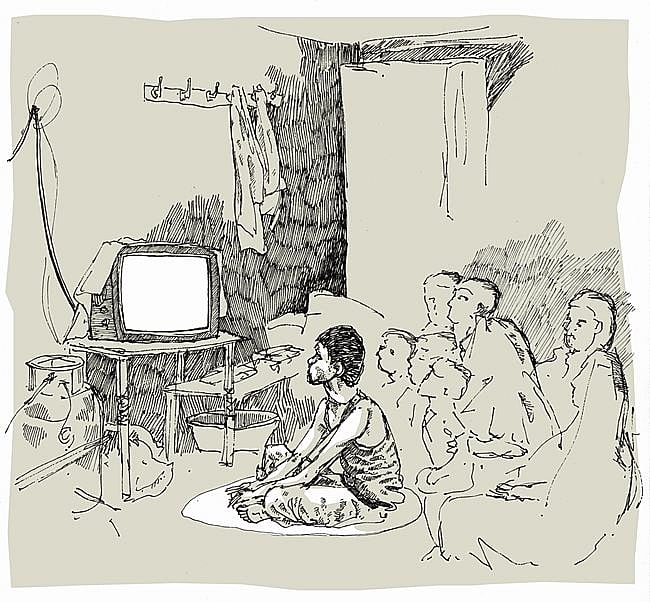
However, those days of agony were soon to be over. It was early 1984 when television first arrived at Mangaldai. As the relay-tower in Guwahati only had a range of about 25 kilometers, getting TV reception required an antenna stuck atop a long pole. In Mangaldai, on the periphery of that range, antennas had to be raised really high for the picture to be clear. Houses with an antenna came to be viewed with respect, as only a few houses had TVs in the beginning. Among our neighbours, the Konwar family – specifically one of the older brothers among the three or four Konwar brothers who all lived in adjacent compounds – got the first TV set.
Soon after the Konwars' antenna went up, Pili proposed that we go over to watch TV the next day. I no longer remember if we skipped school altogether, or if we went to school and then escaped from there (ours was a government high school founded in 1903, and still had no boundary walls back then), but I vividly remember that it was a Thursday. It was the day of Brihaspati, the Guru of the Gods, and my mother did not cook any non-vegetarian dishes on that day, and even avoided using oil. Only the family cat dared to decline the food, as it still had some rights inside the house, whereas the rest of us – my father, my brother and I – had none. However, even the prospect of Thursday's bland food could not dampen my spirits that day. And so Pili and I arrived at the Konwars' drawing room, which was already filled with spectators, to watch the second day's play of a cricket test match.