
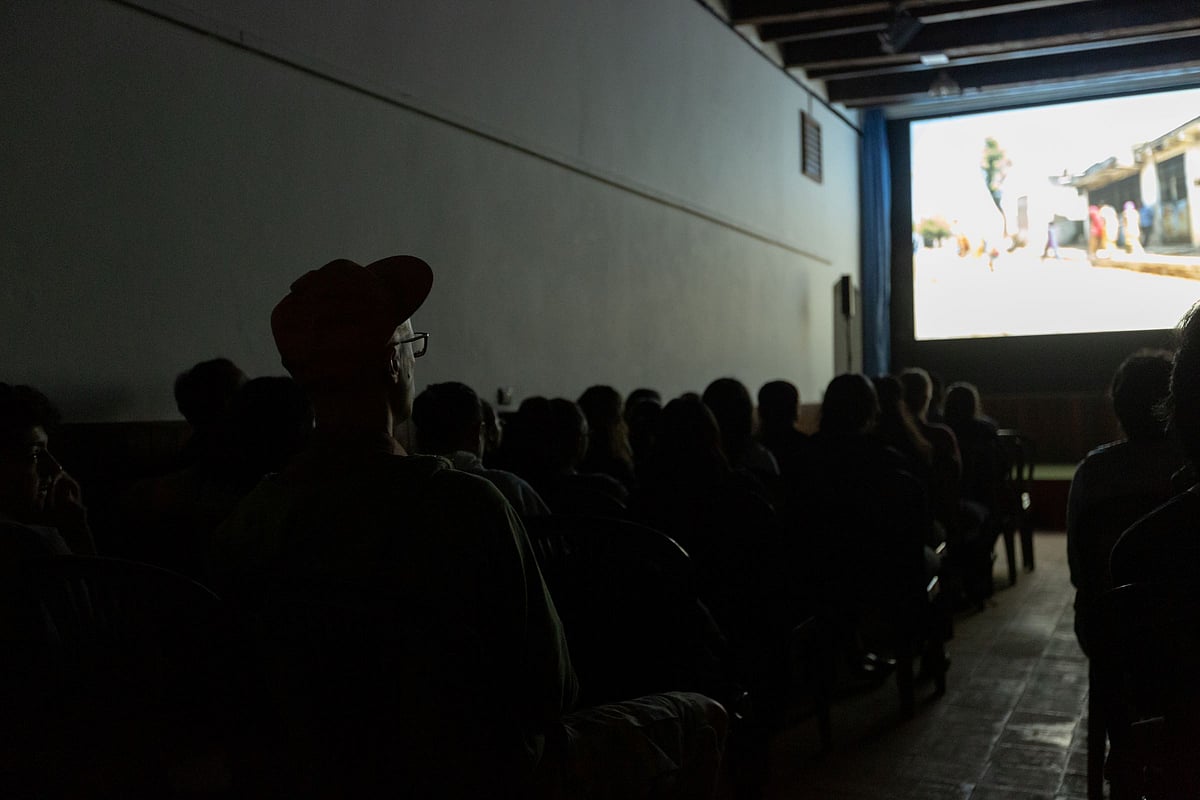
Rushing from one screening to the next during the latest iteration of the film festival Film Southasia, across the sun-soaked inner courtyard of Patan's Yalamaya Kendra, or up meandering stairways of the century-old structure, a number of themes surfaced in my mind. Held in mid-November 2019 in what was its 12th iteration, the biennial festival had simultaneous screenings almost all the time, and one was forced to make uninformed choices along the way. Sometimes I struck gold and left one of the three halls feeling energised and deeply troubled. At others, a little exhausted and perhaps even subdued. By the time the third day of the event drew to a close, I was surprised by the slow and steady emergence of an interweaving of two of the themes that I had been following instinctively – death and education. Beauty, love and resistance, too, had been prominent subjects of documentaries. But it was death that somehow managed to entangle itself quite irrevocably around knowledge, or its dissemination.
For me it began with Pradeep K P's Our Gauri, an homage to Gauri Lankesh – a woman, who until her last breath actively countered the upsurge of communalism in India through her writing, publishing and activism. Highlighting her three major fields of engagement no doubt comes across as banal when written in eulogy of someone whose murder in her Bengaluru home had caused waves of mass uproar and resistance in unexpected corners of the Subcontinent and beyond. But the film evaded this trap of predictable eulogising by opening a window on Gauri the friend, the sister, the human. A series of interviews with family members, colleagues and friends; people on the street who read her deeply political pieces with reverence; people on the street who had joined marches protesting her murder; and most importantly, youth activists she had mentored in various college campuses in India, including the distant Jawaharlal Nehru University in Delhi, replaced her image as an iconic figure of resistance with a far more accessible portrait. It was the portrait of a woman who loved and protected fiercely, and fought her battles even more fiercely.
A prime weapon in Lankesh's battles was the widely respected magazine Gauri Lankesh Patrike, a vernacular weekly that she edited and published to counter misinformation; to mobilise the marginalised, especially those belonging to the lowest rungs of or even outside the oppressive caste system; and to unite the various factions within the pan-Indian leftist movement. Pradeep K P, the director of the film, and a long-time friend, had been shooting footage of her for years. These, when combined with interviews of friends, family and supporters recorded after her death, brought us the story of a woman who fought for the right to education, knowledge and information, and the empowerment that this inevitably brings in its wake. Our Gauri will no doubt mean different things to different people. To me she will remain the one that relentlessly struggled against upper-caste and right-wing-engineered opacity and exclusion, both of which must necessarily revolve around the creation of and access to information, to knowledge and the freedom that entails. Her annihilation was no doubt a structural necessity for this opacity to remain intact.
Less than 24 hours later I was walking out of the venue's Baggikhana Hall, seething with a feeling of helplessness, facilitated by FSA's carefully chosen inventory of films. We Have Not Come Here to Die was a gritty revisit to the 'why's that preceded and followed Dalit PhD student Rohith Vemula's suicide in Hyderabad in 2016. The swirl of campus politics at the University of Hyderabad, of the agendas of various political parties and the university administration, and of caste and discrimination had held us in their thrall for three years now. His suicide note had been widely circulated on the internet and print media. We cannot but know that he equated a person with their mind, with "a glorious thing made up of stardust", as he wrote in his final letter.