
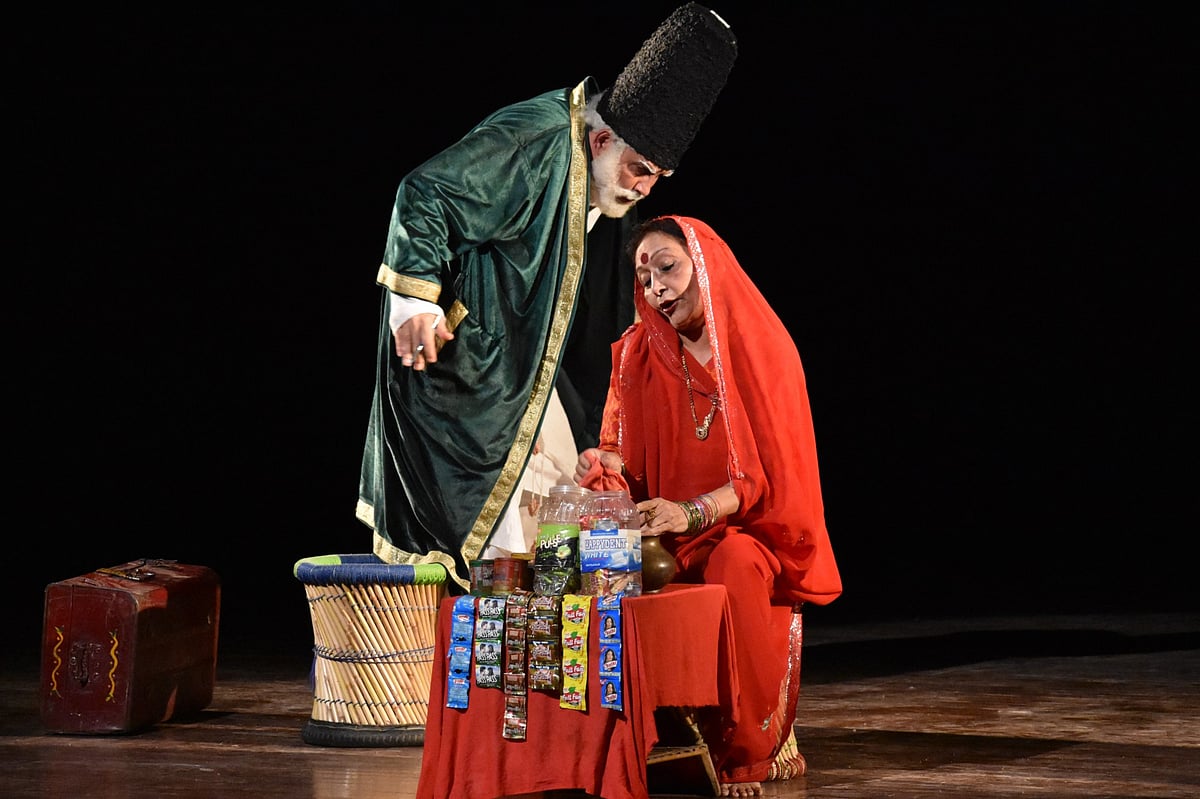
A simple premise: what if the 19th-century Urdu and Persian poet Mirza Ghalib was reincarnated in the present day in Delhi, the city that was his home for most of his life? This idea forms the crux of Ghalib In New Delhi, which has been staged in the Indian capital since 1997, performed more than 500 times over 26 years, making it one of the longest-running comedic plays in the country. The play is satirical, with a dynamic script that changes to reflect the political and social shifts in the capital and the country. Inadvertently, Ghalib in New Delhi has charted Delhi's transformations over the last 26 years, acting almost like a chronicler of the city's recent history.
It is fitting that the play's principal character is Mirza Ghalib, an iconic Delhi-ite who lived between 1797 and 1869. Ghalib was born in Agra, some 250 kilometres from Delhi, and witnessed the decline of the Mughal Empire, which ruled much of Southasia between the 16th and 19th centuries. Ghalib witnessed the rule of the East India Company, and then direct administration by the British government after the Indian uprising of 1857. He began writing at the age of 11 and moved to Delhi at 13 years old, and was there to see and later record the city's ruin as British forces stamped out the 1857 rebellion. While Ghalib's work in Persian is much more voluminous than his work in Urdu, and appeared dearer to him, it was his Urdu work that has fed his fame after his death.
The play has always begun with Ghalib's rebirth at an inter-state bus terminal, where he meets a paan-seller and comes face-to-face with the behemoth that is inflation when he tries to buy paan. The play then follows his initial attempts to get to Ballimaran, the mansion where he once lived, located in what is now known as Old Delhi. On his quest he comes across characters ranging from auto drivers and rickshaw pullers to an alcoholic and a corrupt police officer. The play explores his interactions in a comical manner, while sprinkling in dialogue about what is currently happening in the city.
Eventually, Ghalib finds refuge at the rented accommodation of a Delhi University student living in his landlord's servant quarters. Here he learns about his enduring popularity in the modern day and quickly adapts to the demands of today's consumerist culture – he translates his poetry, puts out ads about his skills and finds success. The last act of the play shows Ghalib out of his traditional attire and lounging in a T-shirt and Bermuda shorts, on a phone call with someone from heaven, recounting his experiences while making several quips about modern Delhi. In the final scene, he makes a remark about a new book he is working on – a running joke of Ghalib in New Delhi. In the latest version of the play, it is titled "Romance in Ghalib's Poetry: A Post-Independence, Post-Modern, Post-Congress, Post-BSP, Post-Samajwadi, Post-Notebandi, Post-GST, Post-370, Post-Sunak Perspective".