
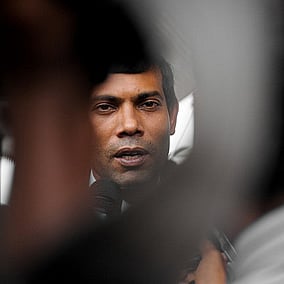
The Maldives is in deep social and political turmoil. On 13 March, the courts jailed opposition leader and first democratically elected president of the Maldives, Mohamed Nasheed, for 13 years on charges of 'terrorism' following a hasty trial that was widely seen to be unfair and lacking in due process. Nasheed was found guilty under the Anti-Terrorism Act of 1990 for the unlawful detention of a criminal court judge in 2012. Two weeks later, in what appears to be a series of politically motivated arrests, former Defence Minister Mohamed Nazim was sentenced to 11 years in prison on charges of smuggling weapons. Nazim's trial, too, has been widely described as unfair. Last week, President Mohamed Yameen's old friend and new foe, Member of Parliament Ahmed Nazim, was jailed for life on corruption charges. In the same week came the acquittal of former army chief and current Defence Minister Moosa Jaleel, Nasheed's co-defendant in the 'terrorism' charge, who joined the ruling Progressive Party of Maldives (PPM) this year. Nasheed was found guilty, the court said, because he had been unable to prove his innocence; in Jaleel's case, the same court reasoned, the prosecution had been unable to prove his guilt.
Mass protests have followed these arrests in the congested capital of Male, and on various islands across the country. On the night Nasheed was sentenced – the entire trial was conducted after sundown – reports from Maldives described an eerie silence across the country as his supporters, over a 100,000 people, tried to come to terms with the enormity of the incident. Two days later, his party, the Maldivian Democratic Party (MDP), rebounded with a resolution to launch a campaign of civil disobedience.
In response, the Maldives Police Service acted with excessive force against the demonstrators, and made a large number of arrests; many protesters have been jailed in the last month, including several members of Parliament. Journalists, too, have been arrested and detained without charge. Many have been released only on the condition that they do not protest again for a specified number of weeks or months – a procedure that contravenes the right to free assembly guaranteed by the 2008 Constitution. Early this month, the police put out a statement saying all protests need prior approval. Curtailing of civil and political liberties has become routine.
The Abdulla Yameen Abdul Gayoom-led government, however, is adamant that due procedure was followed in the prosecution of both Nasheed and Nazim. Following Nasheed's sentence, President Yameen's office issued a statement on 14 March calling on everyone to respect the court's verdict. Foreign Minister, Dunya Maumoon – Yameen's niece and daughter of former leader Maumoon Abdul Gayoom – has led the efforts to deflect international criticisms, which have been abundant. None of them have been convincing.