
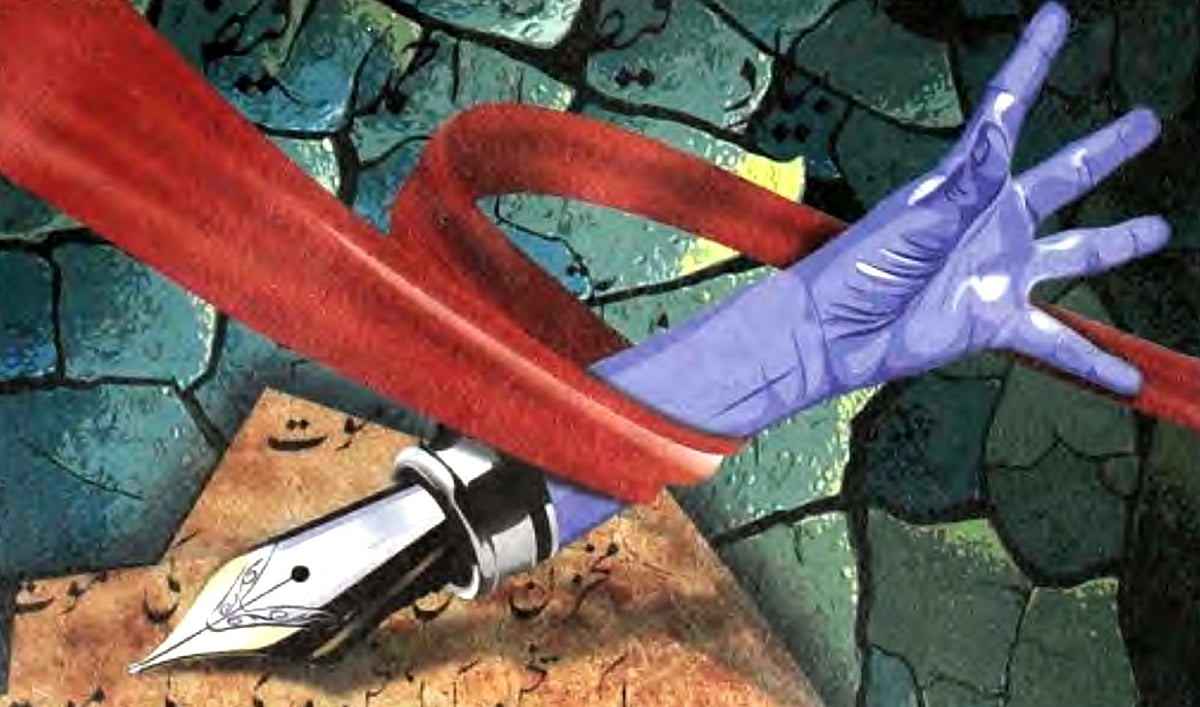
Politics and history are commensurate. At the worst of times, when upheaval and change are the order of the day, so are politics and poetry. There can be no better example of this axiom in the 20th century than the poetry of Faiz Ahmad Faiz, who wrote prolifically and compellingly on the events that shaped today's Subcontinent. Apart from his prodigious output as a poet, Faiz also wrote newspaper editorials and articles, and gave interviews on a range of subjects that, taken together, reveal a highly political mind beneath the poet's persona and demonstrate the astonishing range of his concerns and interests. Our interest here is in Faiz's prose writings and the similarities and differences with his poetry. While admittedly the comparison itself – between prose and poetry – is unfair and the two are, by their very nature, as unalike as apples and oranges, when the writings come from the same pen they inevitably arouse curiosity and critique.
The War in Europe affected India and Indians in strange ways. After the Nazi invasion of the Soviet Union in 1941, Faiz's pacifism changed. He joined the welfare department of the British army in 1942 and was put in charge of publicity. He served in the army till 1947 and was given an MBE for his services, and raised to the rank of lieutenant-colonel. He wore a uniform and served His Majesty's Government, not for guts or glory but simply because he believed fascism had to be fought at all costs and by whatever means available. But with the war over and his teaching days behind him, Faiz found himself in search of a regular job.
Sometime in early 1947, the Progressive Papers Limited was established in Lahore by Mian Iftikharuddin, and Faiz was offered the job of editing Pakistan Times and heading the editorial board of its sister publications, the Urdu daily Imroze and the literary and political weekly Lail-o-Nahar. Faiz was then only 37 years old. As the editor of the Pakistan Times, the English-language left-leaning newspaper from Lahore, he wrote on an array of issues from 1947 until his arrest in the Rawalpindi Conspiracy Case in 1951.
To instruct and inform
It is in these English writings that one gets a taste of what Faiz had set out to do when he, along with a group of like-minded young men, established the Halqa-e-Arbab-e-Zauq or the Circle of Men of Good Taste. Set up in 1939, the members of the Halqa set themselves up as the arbiters of good taste in matters of poetry, prose and politics, and continued to exercise a prominent influence on the Pakistani literary scene long after the waning of the PWA. The Halqa demanded nothing of its members save a vaguely defined aestheticism that did not shy away from individualism and subjectivity (both, incidentally, anathema to the 'hard-core' progressives). To the modern reader the name of this loose coalition of 'literary types' – many of whom had overlapping membership with the PWA – may seem pretentious and snobbish but it was, during its time, a much-needed corrective for the progressives who held all matters of 'good taste' in lofty disdain and prized ideology above all else. It might, for this reason, be instructive to read Faiz's editorials in the context in which they were written. Their purpose was not merely to raise a voice of dissent or create a platform of resistance for the sake of a laid-down ideology; their purpose was, I think, to instruct and inform, and when his conscience so demanded, offer a critique.