
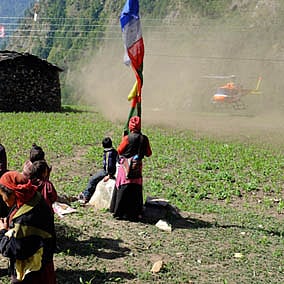
It is distribution day in Bihi. Tarps, noodles, rice and daal are piled outside the local mill in this village in northern Gorkha. The mill has now been turned into a storage for relief supplies. A ledger with household names has been prepared and the Bihi residents, from children to elders, crowd around. A name is called, then a walk down the line: one mana (a unit of volume for cereals, little over half-a-litre) of daal, one bag of biscuits, eights packs of noodles, a roll of rope, one tarp, one guak (another local measurement, about 1.5 litres) of rice, and a plateful of chiura (beaten rice). The straightforward nature of the scene betrays the work needed to organise this affair: the intense manoeuvring required to ensure a reasonably fair distribution of relief materials, as the influx of donations meets Nepal's local politics.
Just when Tsering, a local representative, is about to call the name of the first household, the now familiar sound of a helicopter rings through the valley. As the helicopter sweeps into the neighbouring field, some try to protect the food from the dust while others move closer to see who is coming. It is the World Food Program (WFP). They have come to assess the situation, 16 days after the quake. How many people live in the area? How many houses destroyed? Have stored food been lost? What do they need? Questions follow in quick succession to the circle of people quickly formed around the WFP representative. Five minutes later, the helicopter departs. Left behind is the promise of large quantities of rice – 10 kg per household – arriving soon.
With the dust settled, some confusion arises. Is the distribution still on? Or should we wait for further relief materials? And will they really arrive? We continue. Even at the best of times, it is tricky to plan relief distribution. Should households or individuals be the basic unit to work with when giving aid? Should it be based on needs or should the materials be distributed evenly? And who decides what needs are gravest? When uncertainties about future relief are added to the equation, the complexities are compounded, stretching calculations beyond the edges of your notebooks.
On top of this, Bihi – like many other Village Development Committees (VDCs) in Nepal – presents a heavily politicised environment. Rumours of corruption surround the VDC head, a man whose position has not been legitimised by the public; the last local elections in Nepal were 17 years ago. Hospitalised in Kathmandu, he is not present in Bihi at the moment. In his absence, a committee has been formed to oversee the distribution, which includes members from the local youth club. For several of them, their fathers are or were members of the opposition party, and have been in sharp conflict with the VDC administration. In the past, the conflict has been expressed in death threats and vandalism. Now, rumors of people 'eating' the relief materials thrive.