
Two years ago, I was in Kolkata while the city performed her annual Durga puja. After a dinner party, a group of friends and I left an apartment with a view to visiting the nearby Navadurga temple. We were welcomed by nine supposedly different representations of Durga's various aspects, all exact lookalikes. Standing upright, one next to the other, they resembled a crew of Bollywoodised flight attendants: blindingly white and tawdry mannequins with flagrantly rouged lips stretched into Mona Lisa smiles. It seemed as if Durga had been sublimated beyond recognition – there were no vestiges of her resolute self on any of those uniform, bleached out faces.
The real surprise, however, awaited in the adjacent room. Tucked into a wall niche was a miniature, dark-skinned Kali, decked with tribal beads and wrapped in a piece of colourful cloth the size of a handkerchief. At first, she looked like an ordinary straw doll. The black goddess was so strikingly inconspicuous – a dethroned and exiled splint of darkness. How had she shrunk to such infinitesimal proportions? What had happened to her, and whose company had she been keeping?
Some answers to these questions can be found if you dig through the prodigious bulk of scholarly work on Indian goddesses. You will be able, in some cases, to trace their origins all the way back to the pre-Aryan fertility cults, and the Great Mother Goddess, dark and primal. But to observe the contemporaneous vicissitudes of this link, its ongoing dialogue with the present, one would need to take a look at the equally prolific literary and artistic output that centres around archetypal female characters passed down by the great Indian epics, the Ramayana and Mahabharata. Semi-divine and pseudo-human, they echo the proto-goddess in ever-changing scenarios and rewrites.
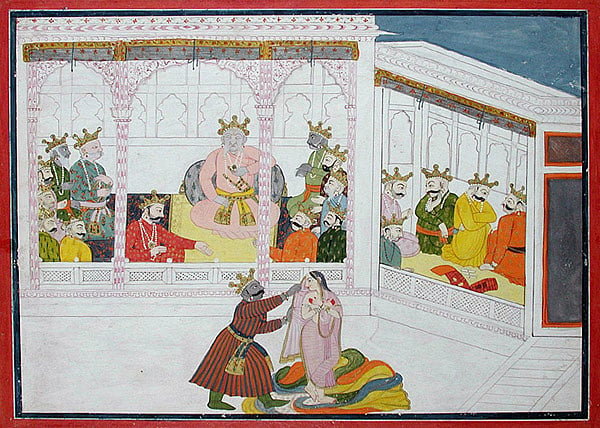
When trying to identify the more transparent incarnations of the Black Goddess, Draupadi comes to mind. This epic heroine with blue locks and short temper – one of the leading female characters of the Mahabharata – is also known as Krishnā, or the Dark One (the long 'a' indicating the feminine gender in Sanskrit, as opposed to the Yadava prince Krishna, with whom she shares a special bond). Many scholars advocate her Dravidian origins. Also the embodiment of Shakti, Durga, Kali, or the Earth itself, she has taken on flesh in numberless revisitings and adaptations of the epic.