
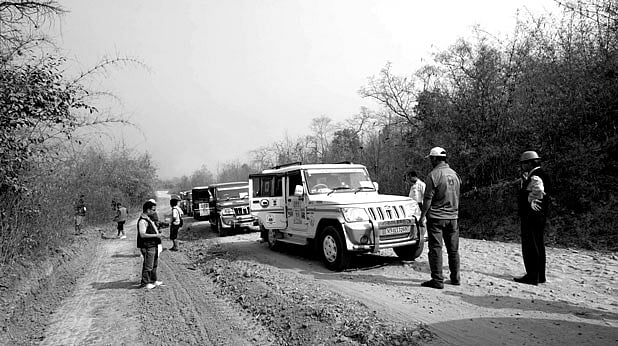
The road from Tamu, the Burma township just across the Indian border, to Kalemyo via Kalewa, could have been any Indian road in terms of construction quality and feel. This is hardly surprising, for this 160 km stretch of two-lane asphalt was built by India's BRO (Border Road Organisation), and inaugurated in 2001. Its maintenance is also under the charge of the BRO, and occasionally, as we cut through virtually uninhabited peripheries of the Sagaing Division of the country, BRO vehicles, road construction machinery and earth movers became a familiar sight.
We bypassed Kalewa and arrived at Kalemyo, the larger and busier of the two adjacent towns for a night's halt. It felt as though the entire town was waiting for us. Burma's enthusiasm and hunger for change was evident in every one of the thousands of faces along the road, waving as the rally cars cruised into town. Everybody was eager to please us, almost to the point of embarrassment. From the petrol pump handlers where we queued up to refill, to the sparse staff in the few modest hotels where we were booked, everybody was apologetic that their service may not match our expectations. They were, they said, still adapting to what they see as Burma's brave new world, hurried in after more than half a century of almost complete isolation, imposed by a tough but insecure military junta.
"Please bear with us. We are still learning," explained the young manager of the hotel I was to stay in, and his staff went around the lobby telling each of the visitors the same as we waited for our respective rooms to be allocated. I could not help wondering that while this evident hunger for change can provide the impetus for Burma to free itself from its current circumstances and join many of its neighbours – aptly referred to as the Asian Tigers – it may also result in disappointment. Amid the current euphoria and optimism in Burma, there are worries too that these hopes could be belied by the absence of an enlightened leadership. After 60 years of dictatorship, the majority of people have remained impoverished, while the wealth of this resource-rich country has been funnelled into the hands of less than one percent of the population, those in or close to the erstwhile military regime. Many analysts still describe the Burmese government as a proxy of the country's military.
This dichotomy between rich and poor is evident everywhere. During the rally, there were hardly any motor vehicles on most of the roads, but every now and then, expensive SUVs and sports cars would whizz past us. This coterie has the money, but there is little in the way of an entrepreneurship culture, so they end up investing their money in property. Due to the buying spree since Burma's liberalisation, price tags on real estate in Mandalay and Yangon, as well as other major cities, have escalated dramatically. Property prices in Mandalay are now said to have surpassed those in Bangkok.