
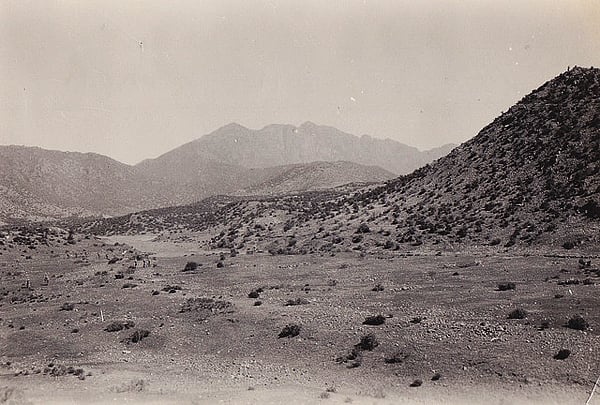
Until a few years ago, Mohammad Sat Sayeed – from Kalkatak village in northwestern Pakistan, on the eastern bank of the River Chitral – was the last speaker of a language on the verge of extinction. Fellow villagers used to hear Sat's supplication in his native Kalasha: "O, mi ganahxudai mi muafkeri; O! Almighty, please forgive me." He was the last speaker of this language, and would often speak it in public. With Sat's death, the last vestige of a forgotten chapter of the region's history has vanished, when Kalasha was a part of Kalashgoom, or the land of the Kalashnon-Muslims.
The death of language and the loss of Kalash cultural identity at Kalkatak can be seen as the culmination of a long process of subjection to other dominant cultural and religious influences. Colonel John Biddulph, a colonial official and author who visited Chitral, noted in his Tribes of the Hindoo Koosh (1880) that many villagers in Jinjret, Loi, Suwir, Nager and Shishiare Kalash had converted to Islam. He also noted that those villagers who lived in the vicinity of Kalkatak followed their ancient customs and spoke the Kalash language.
Over the course of a century, these villages lost their distinct Kalash identity, and it is questionable whether contemporary residents are even aware of their heritage. A similar pattern of cultural loss is likely to continue in the region in the future, given that complex patchworks of languages and dialects spoken by ever-smaller communities are spread over a huge and largely remote mountainous territory. This region has for centuries been at the crossroads of movement between the Central Asian steppes and the Indian plains, shaping its rich and diverse cultural tapestry. Perhaps this interplay of diverse cultures is the reason that the Hindukush-Karakoram region of the Khyber Pakhtunkhwa and Gilgit-Baltistan areas is home to around half of the languages and dialects spoken in Pakistan. Linguistically it is an interesting region, as it contributed the word 'khaki' to the English language, meaning earthen, derived from khak, the Persian word for dust, the colour of the landscape. Khaki-coloured fatigues were first used by the Queens Own Corps of Guides, stationed at Mardan, and replaced the bright scarlet uniform of the British military which had made soldiers easy for snipers to spot against the dun-coloured landscape.
Window to an unknown world
In the north of the country, nestled close to some of the world's highest peaks, the tiny mountain communities have so far preserved this linguistic patchwork. It is one of the most multilingual places on earth, especially interesting compared to the rest of Pakistan where few major languages are spoken by millions. However, as communication technologies break down barriers and distances, questions emerge about the future of smaller dialects. Most are succumbing to the influence of Urdu and other major regional languages, growing and spreading through education and better communication. Over three decades of war in this region have also impacted these languages.