
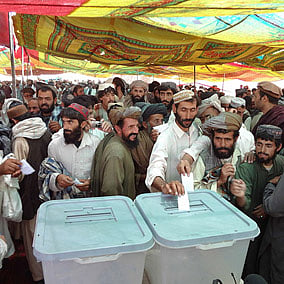
All the nation states of Southasia make claims of being democracies, but this description merely affirms the fact that all nine of them hold elections of some kind. The practice of democracy itself varies widely, however, as it is determined, in the first instance, by the individual electoral systems. The electoral laws followed by each country lead to wildly different forms of representational politics. The rubric of 'democracy' often disguises how different they may be as the bustle of politics and the noise of politicians diverts attention away from the processes by which they come to power. In the absence of further information – the electoral procedures and the nature of the legislative (or executive) structures they create – that description is not just incomplete; it is misleading.
As Afghanistan struggles to define its electoral mandate for the country's next President, Himal Southasian presents a quick study of Southasian elections in an effort to draw attention to the wide range of practices in the region. The front-runner of the first round of polling, Abdullah Abdullah, who was far behind Ashraf Ghani in preliminary results, has rejected the UN-supervised audit of elections, adding that "he was and is the winner of the election based upon clean votes." This brings to mind the 2013 Maldivian presidential election that was considered to have been stolen from under the nose of former President Nasheed.
The absolute majority achieved by Bharatiya Janata Party in the Indian Parliament disguises the fact that the party got only 31 percent of the popular vote in the recent elections demonstrating that the number of parliamentary seats does not always reflect the vote share of the parties. India continues to follow the first-past-the-post (FPTP) system that is increasingly seen as being less democratic than alternatives like proportional representation (PR) or mixed proportional representation that Nepal, for example, adopted for its Constituent Assembly. Yet the limitations of this system are seen clearly in the case of Sri Lanka, where a Parliament elected through mixed proportional system is constricted by the authoritarian powers of a directly elected President.
In Bangladesh and Pakistan, the state is unable to convince many of the validity of its elections. Bhutan has received accolades for moving to electoral democracy, but still curtails adequate representation by limiting the number of parties in the contest through a complex mechanism.