
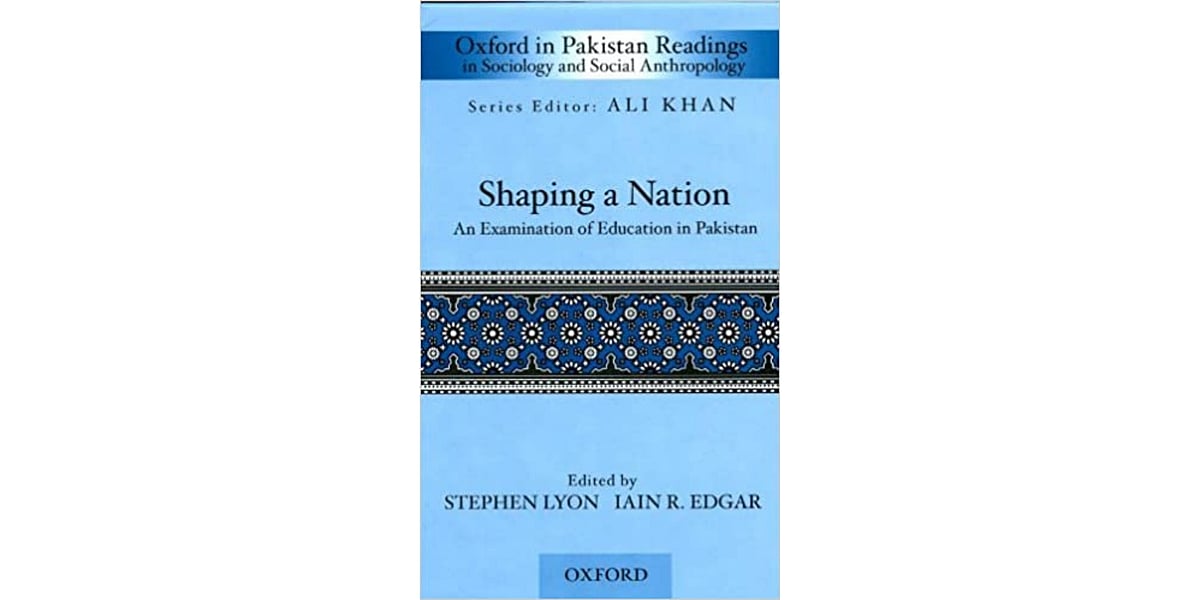
The idea that education will 'make or break' Pakistan is a commonly heard one today. Overall, there is broad agreement that education is as important to Pakistan as to any other country, with reforms required quickly if the people are to see credible results in the near future. On the other hand, the reasons behind the largely unified call for reform vary across constituents. Parents, for instance, view quality education as a way to ensure a brighter future for their children in an increasingly competitive world; analysts feel education might be the only path to addressing outstanding social, political and economic issues; and others, especially non-Pakistanis, consider the reforms, which would include within their ambit the madrassa system, as the only way to prevent Pakistan from imploding, a situation that many fear would cause ripple effects across the region and the world.
With seemingly so much at stake, Shaping a Nation is a timely publication. The articles collected in the volume cover a wide spectrum of topics, and have been written over a long period though they lack explicitly stated dates – Aziz Talbani's paper, for instance, written prior to the attacks of 11 September 2001, could be understood much more readily if one knew it is from the mid-1990s. Nonetheless, collectively they succeed in raising questions sorely in need of debate. At various points, for instance, the authors focus on such critical issues as standardisation of the national curriculum, the place of vocational training, the possibilities for vernacular and international languages, the prospect of establishing government regulation in a country where the state is notoriously weak, and how to set realistic goals to be achieved within a given timeframe. Having articulated these concerns, the authors offer a wealth of alternatives to the current broken system.
As passed in April, the 18th Amendment to the Constitution has made access to education a basic right for children between the ages of 5 and 16. But it remains an unanswered question as to how this can be put into operation while the state continues to spend little more than two percent of gross domestic product on education. The lack of official priority to education has led not only to a dismal lack of quality in the sector, but also to millions of Pakistani children never enrolling in the first place, and many more dropping out before completing their primary education.
Against such a dispiriting backdrop, Stephen Lyon, an anthropologist included in the collection, cautions the reader to be realistic about the prospects of any eventual reform. 'Ultimately, I believe that any educational reforms which insist on gender or class equality will fail in Pakistan,' he writes. 'Helping Pakistan today necessarily means helping in ways that do not overtly challenge cultural values.' Lyons makes a case for incremental changes to ensure that reforms are both well rooted and instill a sense of ownership in local communities. For example, he argues that policies that push on gender equality and removing the gender gap too fast or quickly might backfire due to cultural issues. But with large gender gaps in education, especially in provinces such as Balochistan, does this approach make more sense than one that takes cultural or contextual mores head-on?