
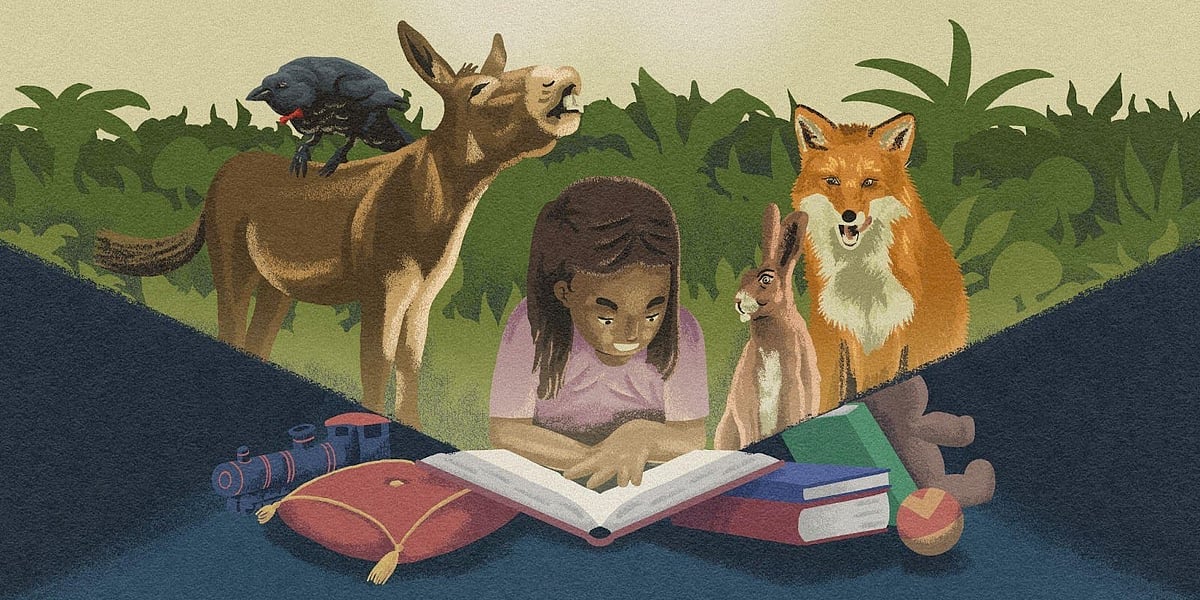
FOR THOUSANDS OF years, storytellers have been concocting moral tales with animated animals. These continue to survive in the form of Aesop’s Fables, first conceived more than two millennia ago in ancient Greece, the Panchatantra, a collection of animal stories originally compiled in Sanskrit, and the Buddhist parables of the Jatakas, among others. Tracing the history of environmental narratives in children’s literature inevitably leads to these ancient fables – some of the earliest known stories featuring wildlife, shared with children not just in Southasia but also around the world. In these fantastical narratives, a motley crew of animal characters, ranging from singing donkeys and smug hares to cunning foxes and clever crows, dispense timeless wisdom on the ways of the world.
These stories were not conceived exclusively for children, nor were they originally deemed to be environmental literature, even though many of them display an environmental sensibility. For instance, in ‘The Monkey and the Crocodile’, a story from the Panchatantra, the monkey is shown as a land animal, living on trees and feeding on fruits, while the crocodile lives in water – revealing subtle observations of the natural world.
The idea of creating literature specifically for children is believed to be an outcome of the Enlightenment, which swept through Western Europe in the 17th and 18th centuries. Philosophers such as John Locke and Jean-Jacques Rousseau theorised that childhood was a distinctive period in human life and articulated the need for children’s literature as a tool for education. In his influential treatise Some Thoughts Concerning Education, Locke specifically recommended Aesop’s Fables as an ideal book to place in the hands of a young reader, “wherein the entertainment that he finds might draw him on … and yet not such as should fill his head with perfectly useless trumpery.”
This idea travelled to Southasia with European colonialists. Even though the region already had a rich history of traditional narratives shared with children, both in oral and written form, tailoring literature specifically for children had not been done here before.