
Southasian newspapers today carry more articles on environmental issues than they ever have before. Perhaps they are forced to do so. There is now relatively indisputable evidence of global warming, including glacial melt and altered weather patterns. This year has already been witness to more extreme weather events than have been seen during any year since the early 20th century. Bitter conflicts over surface water increasingly govern international relationships, and certainly determine inter-state issues within India. More and more, there is a sense that we are on the cusp of a global environmental disaster.
Yet like the rest of the world, governments all over Southasia carry on as though little were amiss, despite distinct possibilities for appropriate action staring them in the face. It is pertinent to ask at this point: Why are urgent environmental concerns not being met with effective policy action, despite the fact that we tend to possess both the knowledge and the resources required to do so?
Part of the reason for our continuing negligence on environmental issues is that, by and large, the average person has little understanding of the complexity of the issues, be it scientific origins, politico-economic linkages or historical cause-and-effect. Few people, for instance, would make the connection between conservation of wetlands (including urban rivers and swamps) and flood control in a mega-city such as Bombay. This is not to say that the person on the street does not feel the impact of ecological problems in various ways. But in Southasia today, there is hardly any literature available for an individual to develop greater understanding of the complex interrelationships behind environmental problems. Newspapers, at best, deal with them in a fragmentary and superficial manner – and, more often than not, inaccurately. As a result, the public constituency for environmental conservation is thin, scattered and localised.
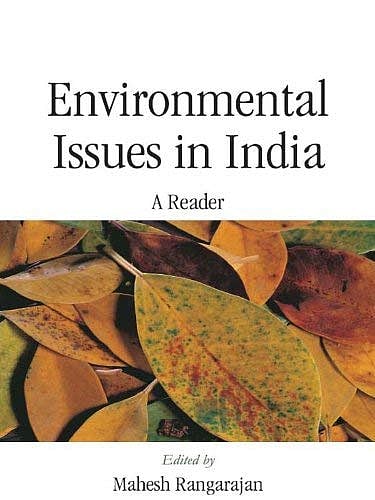
Into this vacuum has come Mahesh Rangarajan's Environmental Issues in India, which brings together a rich collection of voices that treat contemporary environmental problems from a wide range of perspectives and disciplines. Though this realm has remained largely unknown to the public, scholars have for decades been conducting serious research into the political, social, economic and scientific causes behind our developing ecological crises, and it is on this that Rangarajan's book has drawn. The fact that a substantial number of articles in this volume were written by independent scholars rather than what one may call mainstream academicians provides for much-needed presentation of alternative points of view. Important topics from the health of forests and water to pollution and public action are discussed by such eminent scholars as Sumit Guha, Madhav Gadgil, Romila Thapar, N S Jodha, Ramachandra Guha and Ullas Karanth.