
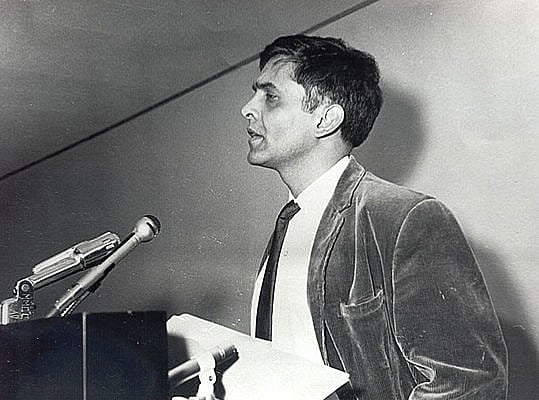
Eqbal Ahmad, activist scholar, was born in India probably in 1934. He's not quite sure. In 1947, he left with his brothers for the newly created state of Pakistan. He came to the United States to study at Princeton in the 1950s, and then went to Algeria. Ahmad worked there with Frantz Fanon during the revolt against the French. He was active in the civil rights movement in the United States and the anti-Vietnam War movement. In 1971, he was prosecuted (along with the Berrigan brothers and several others) on the trumped-up charge of trying to kidnap Henry Kissinger. The case was dismissed.
Ahmad has long been active on the issue of Palestinian sovereignty. This work brought him into a close friendship with Edward Said, who dedicated Culture and Imperialism to him. It also brought him to the attention of Yasser Arafat, who met him several times but, Ahmad says, never took his advice.
In the 1960s, Ahmad taught at Princeton, the University of Illinois, and Cornell. After making a speech to a group of students about the Six-Day War between Israel and the Arab states in 1967, in which he argued that the conflict was more complicated than the media were portraying it, he found himself ostracised in the academy. "A large majority of the faculty at Cornell took great exception to that," he told me. "For the next year, I found myself increasingly so isolated that sometimes I would sit at the lunch table and large numbers of people would be lining up for a table and nobody would sit at mine."
Ahmad left Cornell, did some freelance work and helped found the Transnational Institute in Amsterdam, which is affiliated with the Institute for Policy Studies in Washington DC. From 1982 to 1997, he taught International Relations and Middle Eastern studies for a semester each year at Hampshire College in Amherst, Massachusetts.