
History is a slaughterhouse
– G W F Hegel
But for the suppression of Communist International documents from the post-Lenin years, the subsequent series of splits and divisions among the world's communist parties might have been nipped in the bud. This dynamic cannot be blamed on the then-head of the Communist Party of the Soviet Union (CPSU), Nikita Khrushchev, whose controversial 'secret speech' to a closed session of the 20th Congress of CPSU in 1956 denounced Josef Stalin for the personality cult he had fostered, and for his reprisals against those who differed from him politically and ideologically.
The 'secret speech' was not the only point at which the 20th Congress saw a departure from Stalin's ideas. On the opening day of the Congress, Stalin had presented a report on behalf of the CPSU's central committee that interpreted the party's ideology so as to allow for peaceful transitions to socialism, and for the extension of an olive branch to 'bourgeois nationalist' parties such as the Indian National Congress. Such interpretations seemed to suggest a return to the ideals of Vladimir Lenin, from whom Stalinist ideology had made a sharp departure. Following the Congress, CPSU veterans who had collaborated with Stalin launched an inner-party offensive against some of the major conclusions in the report. The seeds of a schism were thus sown that were to quickly grow into a global phenomenon – one of particular importance to the Third World.
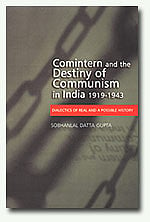
Until the opening of the Communist International (Comintern) archives in 1987, historians had to depend mostly on the Comintern journal, Imprecor, to try and understand these inner workings. Since then, however, researchers have been able to uncover a mountain of information about the Comintern's actions around the world, including in India. University of Calcutta political scientist Sobhanlal Datta Gupta's new Comintern and the Destiny of Communism in India, 1919-1943 – which also makes use of the archives of the Communist Party of Great Britain and of the private collections of a communist veteran – is a path-breaking contribution in this genre. In particular, it gives new insights on revisions of the CPSU's position on the so-called 'colonial question' – its stance on the struggle for liberation from imperialism. For students of the history of the process of national liberation in the Subcontinent, this is exciting material.