
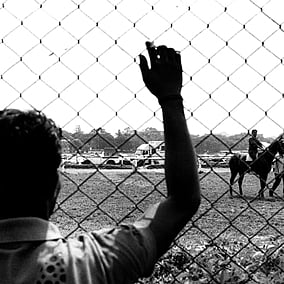
In February 2012, over 1000 syces (stable grooms) from the Bangalore Turf Club were evicted from its premises following a strike. The syces had been demanding a wage raise from USD 78 to USD 113 when negotiations turned violent. The police intervened in response to the Club management's complaint that the protesters posed a 'security threat'. Over two dozen of these evicted syces living on the streets were later picked up by the police on charges of violence under Section 307 of the Indian Penal Code. Four months later, the Karnataka Race Horse Workers' Welfare Association (which represents the workers at the club) announced an indefinite strike; among the demands was an end to unfair practices against the syces, and a revised remuneration of USD 113.
Syce, or sāis in Hindi, refers to those who are employed to groom and take care of horses. Tracing the word's etymology, we come to the word sāsa, which in Arabic means 'to tend to' or 'manage', and also the word sūs from Hebrew which means 'horse'. The British were the first to use the word syce when they occupied India. In the 17th and 18th centuries, British officers stationed in the colonies took the hot-blooded oriental stallions of the Arabian, Barb or Turcoman breeds to England, where mares of mostly English breeding were crossbred with these imported stallions. Their foals, developed for racing and other sports, came to be known as 'thoroughbreds'.
Thoroughbreds are usually measured in 'hands': each hand is four inches, and the average thoroughbred is around sixteen hands high. At the Bangalore Turf Club (BTC), when I asked Naved, a syce who hails from Kishanganj, how long he had been working here, he brought his palm down to his waist, adjusted it for a measurement, and said, smiling, "Since I was this tall." Some of the syces here have been around for close to forty years now. For most of its history, the syces working at the racecourse came from Tamil Nadu. But in the last few decades they have been replaced by the men from Kishanganj, which comes under Purnea (Purnia) division in Bihar. Purnea was a military province during Mughal rule and had a strong cavalry to protect its long borders. Many men from the area now work as syces across the major racing centres in India.
Syces are men who share walls with their prized wards and are on call at all hours. The job not only consists of washing the horses, grooming them, making their beds, and feeding them regularly, but also handling them and keeping them calm. Getting bitten or kicked by a horse is part of the work. Some trainers believe their horses fare better with other animals, like goats, cats, hens and dogs, around them. So these animals too are raised by the syces, inside the confines of their stable gates. The syces get two weeks off a year, in April, when the racecourse is shut and the horses are resting. After returning, they get back to their horses, grooming them to become winners.