
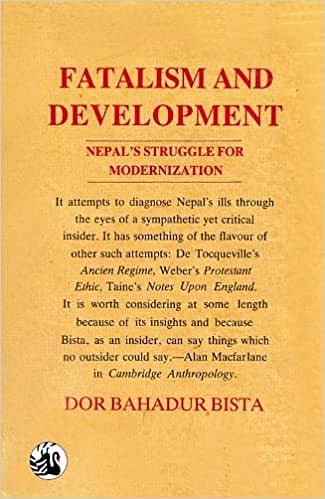
Underdevelopment is a complex phenomenon. One of the promises of Dor Bahadur Bista´s book is that some of this complexity with regard to Nepal may be understood from die point of view of a native anthropologist of proven sensitivity and understanding of Nepali society and culture. What one gets from Fatalism and Development, however, is truly a mixed bag.
The book is a remarkable collection of valuable insights, pointed and accurate criticism, sympathetic and liberal portrayal of the Nepali under-classes, jumbled together with common and unoriginal descriptions, faulty and often-spurious analyses, out-dated development theory, and, unfortunately, myriad stereotypes and clichés about non-Western societies. The book´s virtues, as well as its failings, derive from this essentially schizophrenic mould.
In this book, Bista assumes the challenging task of demonstrating that the lack of rapid economic development in Nepal is caused largely by what he variously calls ´fatalism´, ´Bahunism´ and the ´culture of fatalism´. In sociological terms, Bista wants to show that a particular configuration of cultural and ideological practices (´fatalistic hierarchy´) has an identifiable and negative impact on Nepal´s economic development. Readers are alerted early that the author is dissatisfied with previous attempts to explain Nepal´ s poor economic performance. He laments that "a great majority of the critics like to focus on politico-economic aspects of the society for every evil of Nepal. Rarely do they look into the socio-cultural and religious values."
Bista attempts to remedy this by proceeding to explain "every evil" of Nepali society in terms of "socio-cultural and religious values." At one level, he does advance some intuitive, appealing and even plausible hypotheses about why Nepal is poor, under-deveioped and ill-equipped to tackle the modern era. The answer, as Bista never tires of repeating, lies in the insidious ´culture of fatalism' that pervades the mind, spirit and actions of Nepalis who are "socially located to mediate relations between Nepal and the outside world".