
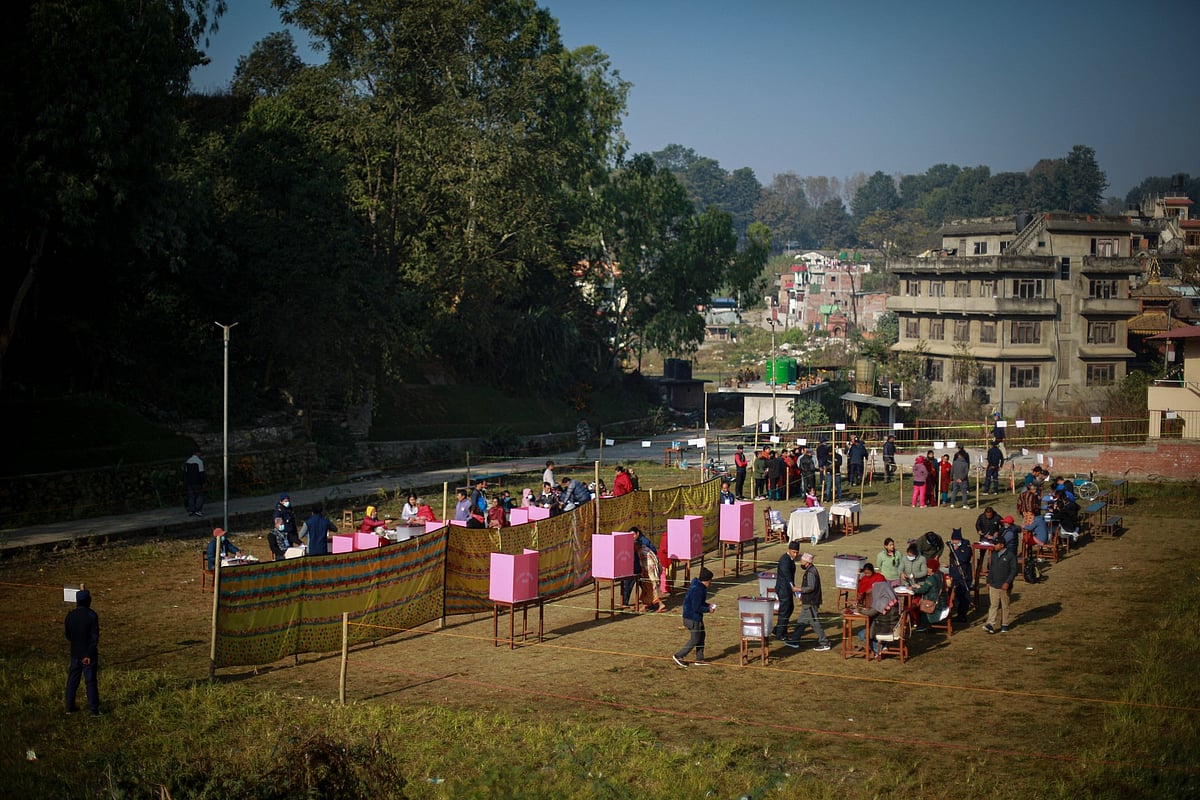
After the federal and provincial elections in Nepal in November 2022, the rise of newer parties dominated the news. Kathmandu was especially buoyant about the surprise emergence of the Rastriya Swatantra Party (RSP) – a makeshift outfit set up six months before the elections by a bombastic television personality (in)famous for his sting journalism, Rabi Lamichhane. The subsequent controversy surrounding Lamichhane's citizenship – it emerged that he had not completed the process of reacquiring Nepali citizenship as per Nepal's laws – added more intrigue to his story. The RSP's rise was paralleled by the ascent of two parties from outside Kathmandu, the Janamat Party (JP) and the Nagarik Unmukti Party (NUP), but they were far less discussed.
The true winner of the 2022 elections was Pushpa Kamal Dahal, alias Prachanda, the former Maoist guerilla leader and now chief of the Communist Party of Nepal (Maoist Centre). His party lost 19 seats from the last election, holding on to only 32 seats in the 275-member House of Representatives. Yet he managed to land the prime ministership with near unanimous support from parliament in his first vote of confidence. Dahal cobbled together a coalition with the Communist Party of Nepal (Unified Marxist Leninist) by breaking his party's pre-election alliance with the Nepali Congress. The coalition also formed governments in all seven provinces of Nepal. Even the ostensible opposition, the Congress, voted in support of the government in parliament, with only two parliamentarians voting against Dahal. The near unanimity disguised the instability that has been inherent in Nepal's polity. This became apparent when Dahal soon changed his tune and supported the Congress's candidate for presidential election, instead of the preferred choice of his governing partners in the UML, effectively breaking the hastily put together post-election coalition. Dahal remains the prime minister now, but with the Congress as governing partner and the UML pushed out.
The convenient switching of alliances between parties despite ostensible differences in ideology has been a norm in Nepal's competitive politics. The three major parties – the Nepali Congress, the UML and the Maoists, with their respective claims to social democratic, Marxist-Lenninst and Maoist doctrines – have played so much bait-and-switch with different political formations to gain power that their stated ideologies have stopped having any meaning. Even the new RSP, which rose rapidly with a strong anti-establishment stance before the election, has till now opted to support any formation of the ruling coalition. Its core ideology is unclear, and also, by their own claim, irrelevant.
Several political commentators stretching back to the 1990s have credited the "de-ideologisation" of Nepali political parties as one cause of the country's incessant political instability. The political scientist Krishna Hachhethu, speaking of coalition politics in the late 1990s, argued that "all parliamentary parties have, time and again, abruptly disregarded their own distinct political identity for the sake of power." This assessment is repeated even today by political analysts. The coalition put together by Dahal to garner a majority in the new parliament included leftists and communists of different persuasions, royalist-nationalists, sub-nationalists and the RSP, a party that does not even have a clearly stated ideology. This makes it easier for parties to switch between coalitions for power grabs and presumably makes Nepali politics more unstable.