
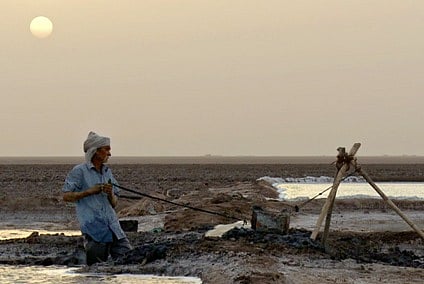
In the documentary My Name is Salt (directed by Farida Pacha), set in the saline desert of Little Rann of Kutch in India, a sequence shows the middle-aged protagonist fretting over the quality of salt crystals forming in his fields. "Leave it to the sun", advises a fellow farmer stoically. This quality of chance and the never ending toil that accompanies the life of the rural poor formed the canvas for three documentaries that were screened at Film Southasia' 2015.
The opening film at the festival, Drawing the Tiger, does not focus directly on the question of rural poverty in Nepal. Rather, it follows the rhythms of life of a family that subsists on less than "a dollar a day", as the film's website describes it. Directed by Amy Benson and Scott Squire, a Seattle based couple, the film credits Nepal-based journalist Ramyata Limbu as a co-director. Shot over seven years, the film documents the journey of a young girl, Shanta, who leaves her village for Kathmandu with a scholarship. She promises to return to care for her parents, and help them break out of the trap of poverty. But tragically, she fails to return. The magnificent mountains surrounding the village of Bahunchurra in Central Nepal frame the long days of Shanta's parents, who are deep in debt and under threat of losing their land unless they manage to repay some of their loans.
What stands out is the constant and difficult labour that define Sushila's, Shanta's mother's, days and nights, from planting the maize to chasing runaway goats, to cooking treats for her grandchildren when she visits them in the city. The years of hard work take a toll on her health, and towards the end of the film a doctor advises her not to work. "Then how will we eat", she asks simply. Drawing the Tiger tells the story of how the promise of a better future lies away from the village, through migration to cities and to other countries, and then complicates that promise. It is also a snapshot of the kind of uneven penetration of technology that has marked the rural terrain for much of Southasia. In several sequences, children amuse themselves by watching films on mobile phones, and a neighbour sends word of absconding livestock by calling from across the mountain. All this appears, to Shanta's grandmother, like progress. In a moving sequence, she describes all the ways in which the current condition of her family seems like paradise. In her youth, she recalls, she had to walk to the river to fetch water, and had to work hard for a cup of rice. Now, she said, there was water at the doorstep, and you could buy rice by the bagful. The irony of her dirt poor family described in such terms makes the film a rich insight into the paradoxes of Nepal's development narrative.
Farida Pacha's My Name is Salt in contrast, moves almost wordlessly, creating vivid tableaus from the life of a family of migrant workers, labouring for eight months in the Little Rann of Kutch. Their harvest is salt, and the film begins with the arrival of a pump that will supply the brackish water which will yield the salt crystals. The film moves from long shots of the baking desert, the heat rising in vapours, to intimate mid shot of Sanabhai and his family as they tend to their salt fields. In a beautifully choreographed sequence, the family moves in a bizarre dance, treading the salt with their bare feet, crossing the camera one after the other. It is a joyless dance, one of difficult postures and no ease in movements. Yet the very next sequence shows Sanabhai's young daughter dancing with carefree abandon to music as she plays on the salt field.