
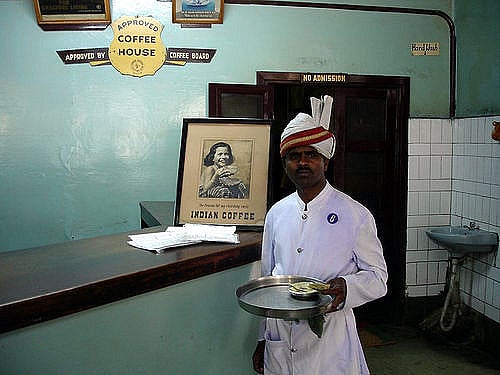
In 1970, I joined Delhi University as an undergraduate student. I decided to take up sociology, a subject that had been introduced recently, so it was taught at the Delhi School of Economics, which was a post-graduate institute. In the middle of the campus was a branch of India Coffee House. That is where I learnt to appreciate filter coffee and enjoyed idlis and dosa for lunch.
By this time, Papa was back in India and was appointed Secretary to Prime Minister Indira Gandhi. It was sometime then that Papa switched to having coffee on the doctor's advice; I do not remember why the doctor had so advised. But Amma bought freshly ground South Indian coffee every week from the shop run by the India Coffee House.
The food and coffee in India Coffee House was good and very cheap. There was a reason behind this. Coffee had been grown in India by native Indians since the sixteenth century and the concept of coffee houses began to gain a little popularity in the eighteenth century in Chennai (Madras State) and Calcutta. However, the English rulers did not allow Indians to enter these coffee houses, and in reaction to this discrimination, the idea of an 'India Coffee House' was born.
The India Coffee House chain was started by the Coffee Cess Committee in 1936, when the first outlet was opened in Bombay. In the course of the 1940s, there were nearly fifty coffee houses all over British India. However, due to a change in policy in the mid-1950s, the Coffee Board decided to close down the coffee houses. This was what inspired the communist leader A.K. Gopalan to organize the workers of the coffee houses and demand that the coffee houses be handed over to them. The movement compelled the Board to hand over the outlets to the workers who then formed the Indian Coffee Workers' Co-operatives and renamed the network as Indian Coffee House. A co-operative began in Bangalore on 19 August 1957, and one was established in Delhi on 27 December 1957.