
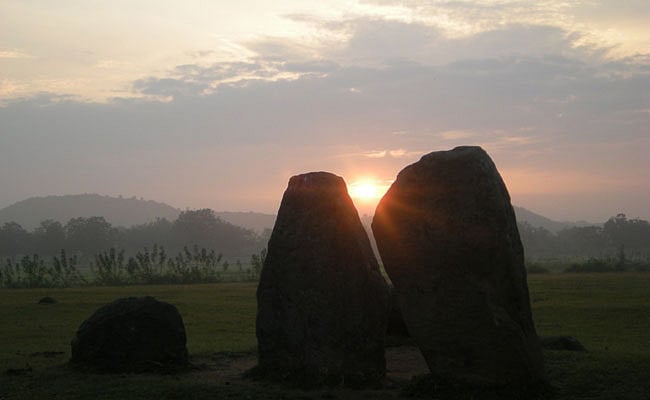
From Kashmir to Kerala, from Itanagar to Gandhinagar, India's countryside is strewn with the remains of enigmatic stone structures known to archaeologists as megaliths. Scores of these were constructed by prehistoric tribes prior to the Aryanisation of India, and they are still being raised today by some Adivasis – possible descendents of those tribes – who continue the tradition. These primitive monuments are an essential part of India's prehistory and archaeological heritage, and yet they have been denied appropriate recognition.
Although the term megalith stems from the Greek words mega and lithos, meaning 'large' and 'stones' respectively, the assortment of structures classified under the term today is fascinatingly wide-ranging. The terminology for megaliths is extensive and varies from region to region, and an entire archaeological vocabulary now exists to describe megalithic structures and features: dolmens, cairns, menhirs, tumuli, barrows, cromlechs, etc.
Especially in Jharkhand and the states of the Northeast, many Adivasis continue to build megaliths as part of complex and varied rituals to commemorate their dead. Once the predominant inhabitants of India, the Mundas, Santhals, Hos, Oraons, Asurs and other proto-Australoid groups are now subjugated and impoverished peoples, and over the years many such groups have gone extinct. However, their historic reign and range is substantiated by the megaliths, many dating back to the late Stone Age which they built across the entire expanse of India.
Excavations at many megalithic sites have revealed graves, often containing a wide array of iron and copper implements – from daggers, arrowheads, and tridents to household items such as lamps, sickles, nails and cooking utensils – and a variety of ceramics and potsherds. In some tombs archaeologists have found ceremonial sepulchral pottery decorated with designs drawn on or etched into the ceramic surface. These designs feature animal motifs and the extensive use of basic geometric shapes such as triangles, zigzags, spirals, semi-circles and loops. Conspicuous thread marks suggest that some of the pottery was wheel-made, and the range of ceramic techniques and decorative styles suggest that this assemblage of relics ranges in origin from before the Bronze Age (which began in India around 3300 BC), through the Iron Age and even, in areas where the custom of megalith construction survived, to the modern era.