
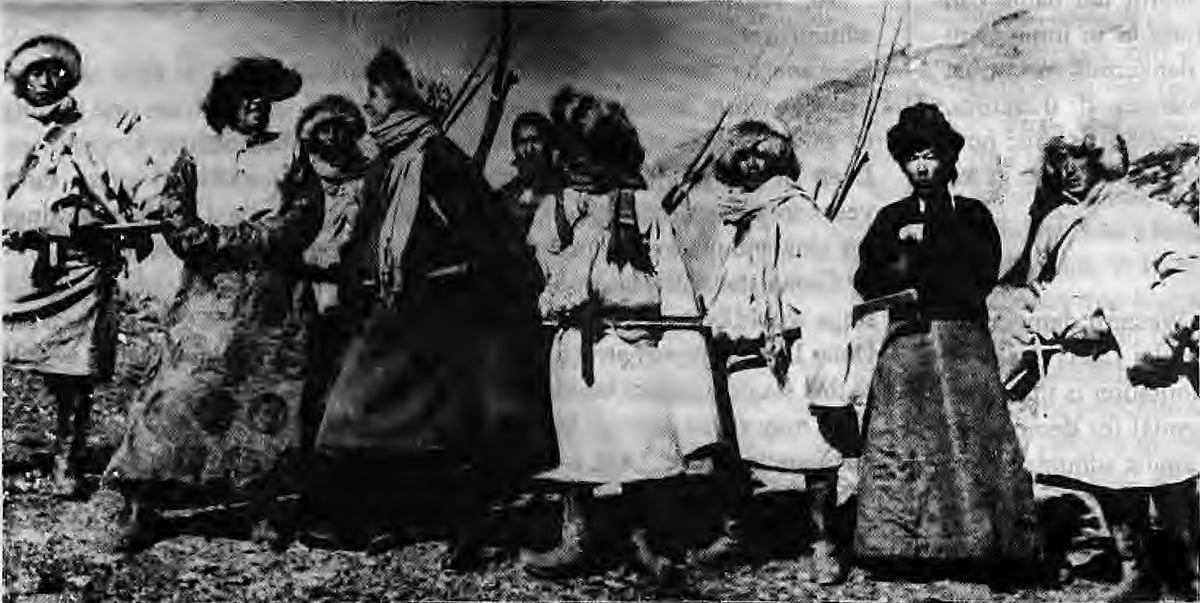
The 23 "tribes" of Kham and Amdo provinces met in Lhasa in July 1957 to form the resistance organization called the Chushi Gangdruk ("Four Rivers, Six Ranges"). It was these guerrillas, together with the Mimang Tsongdu (Peoples' Deputies), who made possible the Dalai Lama's escape to India.
In 1959, the United States Government, seeking to counter the communist threat, stepped up its support for the Tibetan resistance. From among the Chushi Gangdruk members, who were then regrouping in the Uttar Pradesh hill station of Mussoorie, the CIA began its programme of taking Tibetans for guerrilla training to Camp Hale, in the Rockie Mountains of Colorado. So secret was the affair that many recruits never knew they were in the United States. The plan was to train 4100 rebels, in groups of 400, who would launch guerrilla activities from a new base.
MUSTANG BASE
The 750 square mile principality of Mustang, which protrudes from Nepal into Tibet, was chosen as this base, and Gen Yeshi, a Baba-Khampa, as the commander. The rebels set up their headquarters at Kesang, at the base of the Nilgiri Himal across the Kali Gandaki river from Jomosom, and the first batch of 400 arrived. But the news had leaked, and soon hundreds of Tibetans joined the resistance. With its cover blown, the CIA halted its aid for six months. After an arduous winter, help to Tibetans came from a new quarter: India.