
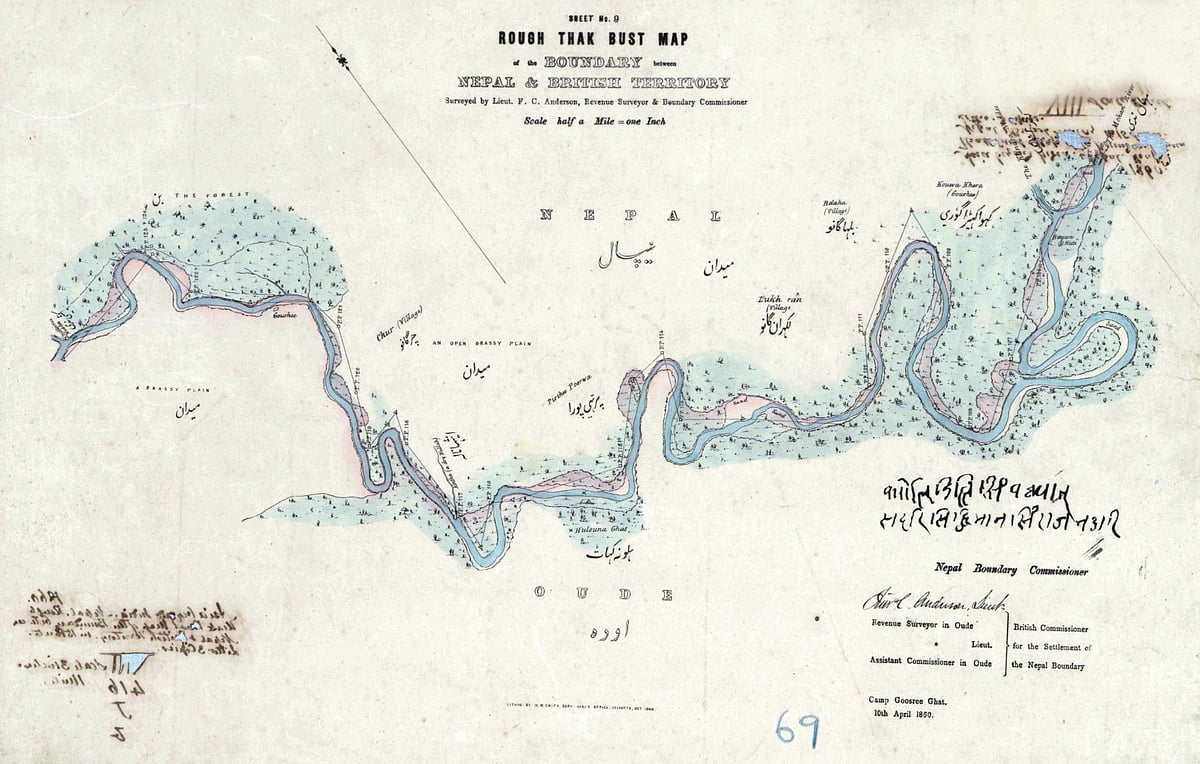
In 1811, one Captain Williamson of the British East India Company arrived at the Anglo-Gorkha frontier, along the northern reaches of what is now Gorakhpur district. Williamson was tasked with demarcating the boundary between the two states. However, his arrival and subsequent inquiries caused some anxiety to the Gorkhali fauzdar (an official) in charge of law-and-order in the area. This official, Maniraj Bhaju, was mystified by Williamson's efforts to draw the boundary in a straight line without any reference to the status of the lands they cut through. This was particularly galling to Maniraj, because Williamson's line cut right through lands where he had recently planted rice! The fauzdar asked Williamson to take his claim to these lands into account and draw the boundary around them. Williamson, needless to say, found this request highly "irregular" and promptly denied it.
This encounter was just one episode in a series of territorial disputes that surfaced in the 18th century, when both states came to share a common frontier. These disputes would be exacerbated along the border districts of Gorakhpur and Champaran, lying in the present-day Indian states of Uttar Pradesh and Bihar (see Figure 1). Three years later, war broke out between the two states only to end with the defeat of the Gorkhalis in early 1816. The East India Company then formally demarcated the boundary separating its territories from Gorkha lying to its north. This time around, every effort was made to keep the line straight, pegged to masonry pillars. To this day, the line marks Nepal's southern boundary with India.
The historical sources pertaining to the war tell a larger story about how this frontier was imagined, constituted, and navigated by communities and kingdoms on the ground, before it became a modern boundary. At a time when Nepal-India relations are at one of their lowest, following a renewed dispute over territories in the western Himalaya, there is growing popular interest in the history of boundaries and mapmaking in the region. In this context, the Anglo-Gorkha conflict and its background are a useful reminder of how the fuzzy precolonial borderlands of Southasia evolved into the neat demarcations of modern-day nation states.
Little kingdoms