
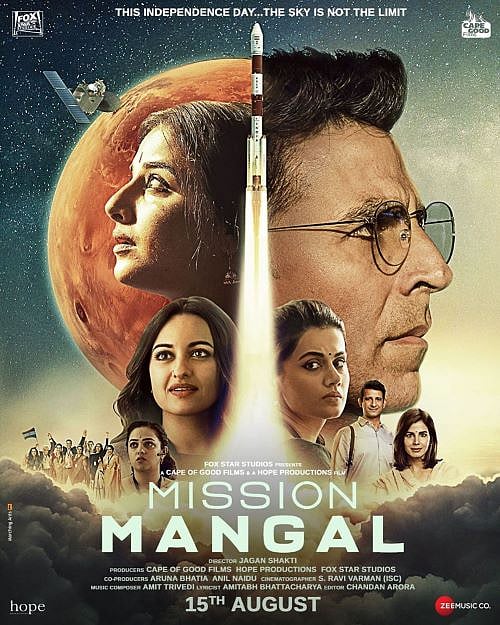
Jagan Shakti's 2019 film Mission Mangal endorses a brand of theatrical nationalism meant to appeal to a nation – encouraged by a Prime Minister with a penchant for performativity – that is looking for 'big bang' moments in history: visually and narratively spectacular events that are discursively produced as radical points of departure from an inadequate past. Mission Mangal reproduces Indian Space Research Organisation's (ISRO) Mars Orbiter Mission – which marks the country's first interplanetary expedition – as a similar 'big bang' moment, one that is meant to herald a new era of technological self-sufficiency and development and consequently, an elevated sense of national pride.
Mission Mangal follows several films, such as Kesari (2019), Uri: The Surgical Strike (2019), Parmanu: The Story of Pokhran (2018), Gold (2018) and The Ghazi Attack (2017) that conform to a trend of aggressive nationalism that has enthralled popular Hindi cinema – and political discourse – in recent times. But it is also a reminder that Hindi cinema has historically been implicated in the task of reproducing a particular mythos around Indian nationhood. In each era, Hindi films have identified the most popular contemporary idiom of Indian nationhood, and altered their ideological thrust to orbit around it.
Since India has consistently been regarded as 'developing' and technology is seen as a metonym of development, it is hardly a surprise then that Indian nationalism is frequently powered by the evocation of homegrown technology. Hindi films have repeatedly attested to the idea that homegrown technology, when harnessed in service of the nation, is the terrain on which the Indian penchant for tradition reconciles uneasily with its desire for modernity. Consequently, discourses on Indian nationalism in popular Hindi cinema have also been tied to temporally specific ideas of technological progress.
Technology and post-independence nation building