
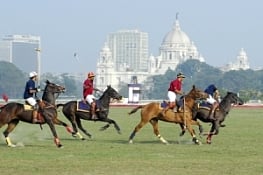
As the warm weather reaches across Pakistan's Northwest Frontier Province, the 3700-metre-high Shandur Valley stirs from its winter slumber, to play host to a veritable anachronism. As the valley greens, tribesmen from near and far gather at the highest polo ground in the world, to be part of a colourful festival of music, dance and ancient sport. The main attraction of the festivities is the polo tournament, played under the light of a full moon between the traditionally rival teams of Chitral and Gilgit. The players observe rules set out almost 800 years ago by Ali Sher Khan, a descendant of Genghis Khan. The excitement generated by the skill, power and speed of this ancient game – one of the fastest in the world – is dramatically heightened by the energy of the gathered crowd.
Polo is one of the oldest team sports still being played. While the game's true origin remains a subject of speculation, many scholars believe that polo emerged from the harsh encampments of nomadic warriors in Central Asia, who are known to have domesticated wild horses more than 2500 years ago. The name itself is said to have come from the Tibetan word pulu, meaning ball. By the fifth century BC, as an elite cavalry under the Persian King Darius I marched across the steppe, the game was taken up as a training technique for mounted soldiers.
The first firmly documented polo game dates back to around 600 BC, between the Turkmen and Persians. Evidence of the strong popularity of polo in Persian society is widely attested to in surviving paintings and scholarly texts. Polo subsequently spread rapidly throughout Asia, from Japan in the east to the Byzantine Empire in the west, patronised by some of the greatest warriors of history, including Alexander the Great and Genghis Khan. Indeed, polo became an integral part of court life of that era. With the demise of those empires, polo too became humbled.
fin By that time, however, the Persians had brought the game to India. There, under the patronages of Sultan Qutb-ud-din Aibak and Emperor Babur, the game flourished, eventually becoming the national sport during the 16th century. Its popularity spread beyond the Mughal courts among the Rajput kings, whose descendents ended up as the patrons of the sport down through the centuries. But once again, with the demise of the Mughal Empire in the late 16th century, polo found itself bereft of royal patronage, and continued to be played only in remote village areas. I