
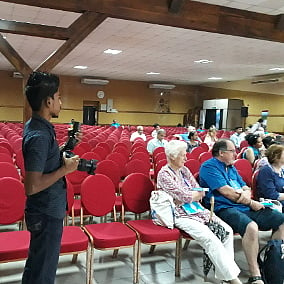
Big names in the world of literature. Globally renowned authors. Poets and performers. The site of the 9th Galle Lit Fest was awash in buntings. But missing from the occasion was a robust audience. While events at smaller venues were overflowing or nearly full, the big hall with starring speakers exhibited row upon row of empty chairs, suggesting the organisers' stress on exclusivity had almost excluded an audience.
The gala's five-day pass was sold out very early, suggesting an intense interest, but the gateway to many an interesting event was through additional payment ranging between USD 7 and USD 70. In addition to the tidy sum of money this must be yielding (16 private events were individually ticketed on day one), the participation of individual authors was also a sponsored affair. The name of the sponsoring company was announced, dutifully and with due reverence, in conjunction with that of the author before each event. The authors – straw polled by Chhetria Patrakar – had not been informed of this sponsorship and learnt of it only through the festival brochure after their arrival. Nor did they know that many of their events required further payments to attend leading some to express their discomfort.
While the Chhetria Patrakar's team was given media passes, CP, having already shelled out a considerable sum on travel and stay felt unable to avail of several of the splendid events. Many other events were not ticketed but required further booking, requiring a considerable feat of navigation. The end result was some sparsely attended events, a real pity given the excellent speakers and good logistical arrangements.
Among the most keenly attended one was a conversation with the author Pankaj Mishra, whose recent book Age of Anger: A history of the present forwards an ambitious thesis to explain the resurgence of far-right politics around the world. At the session, Mishra argued that the confluence of democracy, enlightenment ideas, and industrialisation in the late-18th-century radically transformed the nature of modern man. And the results of these 'rational' ideas – steady economic growth and democratic rights – are often touted as premiere achievements of the West.