
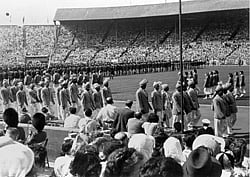
At the turn of the 19th century, when a Swiss aristocrat named Baron de Coubertin first dreamt up the idea of the modern Olympic Games, it was a Eurocentric enterprise. Only later did it develop a life of its own, and spread to other parts of the globe. India was the first colonised Asian country to take part in the Olympic Games. But its embrace of the Olympic movement, at a time when it was still a British colony, was no mere coincidence. Rather, this move was closely linked to forces of nationalism, the politics of self-respect and indeed the inculcation of the British 'games ethic' among Indian elites. Colonial India's early Olympic encounter was born out of a complex interplay of all three factors, and it forms a crucial missing link in the story of Indian nationhood.
It took until 1920 for India to participate in the Olympic Games, and no formal institutional mechanism for supporting Olympic sport was established in the Subcontinent till early in that decade. But by the mid-1920s, however, driven by nationalist enterprise and princely patronage, India's Olympic structure was well in place. The Indian Olympic Association (IOA) as we know it today was formed in 1927 – the second-oldest national Olympic association in Asia, after Japan's. At a time when nationalist sentiment in India was gaining pace, the Olympics were the only international arena where 'Indian-ness' could be projected on the sporting field. As such, India's participation in the Olympics was an important watershed for the politics of colonialism. Indians participated in the Olympics, on equal terms with the British, at a time when the colony was not even invited to the first British Empire Games, in 1930, for what would later become the Commonwealth Games.
Interestingly, India's embrace of 'Olympism' – defined by the Olympic Charter as, in part, "a philosophy of life, exalting and combining in a balanced whole the qualities of body, will and mind" – during the 1920s was simultaneously accompanied by a powerful push of the Olympic ideal into Latin America and Southeast Asia. In all three cases, the same strategy was followed: the use of the global network of the Young Men's Christian Association (YMCA), and the cooption of local elites with enough private resources and European contacts to liaise with the Olympic movement's centre. In a Europe divided by war, the International Olympic Committee (IOC) pushed this expansion as a strategy for survival; in India, the ideal was appropriated by elite nationalists as a new avenue for self-respect, modernity and identity politics in the sporting arena.
From the Gymkhana
To Dorab Tata goes the credit of initiating systematic Olympic activities on Indian soil, in 1920. The son of the pioneering nationalist steel baron Jamsetji Tata, Sir Dorabji (as he came to be known), prior to taking an interest in Olympism, had already played a key role in the establishment of school and college cricket in Bombay during the 1880s.