
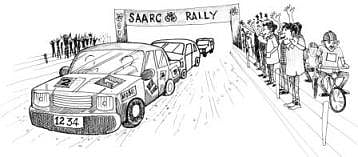
Among the ceremonial events that marked the opening of the 14th SAARC Summit in Delhi in early April, was the flagging-off of a car rally. Beginning two weeks earlier in Dhaka, the rally had briefly halted in Delhi en route to covering all of the member countries (then seven) of the regional grouping, in the space of a month. It was a rather literal-minded effort to underline the Summit's ostensible theme of 'connectivity'. But even as the cars went their way, proudly emblazoned with the emblems of generous Indian corporate sponsors, nine forlorn youths from Maharashtra were making their way back from the Wagah border. They had cycled 2000 kilometres over a few weeks, in the expectation of visiting Lahore on a peace-and-goodwill mission – only to have their visa applications rejected at the last moment.
Is 'connectivity' about a coming together of the people of Southasia? Or is it merely a means of creating greater opportunities for Indian business? Certainly, as Prime Minister Manmohan Singh addressed his summit partners shortly after assuming the SAARC chair from Bangladesh, he seemed to be advocating connectivity in its widest possible sense – a confluence not merely of "physical, economic" attributes, but also "of the mind". Southasia as a region, he said, has traditionally only flourished when it has been connected within itself and to the rest of the world.
Prime Minister Singh was reprising a much-favoured theme: that of the endeavour to make borders irrelevant, and to give the people of the region the wherewithal to move freely across the vast, populated expanses of Southasia, searching out and utilising every opportunity available for both their own betterment and the larger social good. This is undoubtedly a noble vision, yet it overlooks a significant point. As the cyclists from Maharashtra found, they probably do not enjoy the same privileges of cross-border mobility as the owner of a car. While connectivity within Southasia could become a right theoretically enjoyed by all, it may in practice remain the preserve of a mere handful.
To give him due credit, what the Indian prime minister envisages is a situation in which the freedom to travel becomes a reality for a broad cross-section of the people of Southasia. And thus, he promised that India would soon announce a unilateral liberalisation of visa rules and procedures for students, academics, journalists, and individuals traveling for medical treatment. India would also provide duty-free and quota-free access for imports from SAARC member countries that happen to be classified among the "least developed" – excluding Pakistan from the party. The sensitive list of commodities to which the new rules would not apply would, the prime minister assured, be pared down and soon made public. No time frame was specified within which these decisions would be made and operationalised, though the history of SAARC is strewn with promises made in the effulgence of a summit, only to be forgotten just as rapidly.