
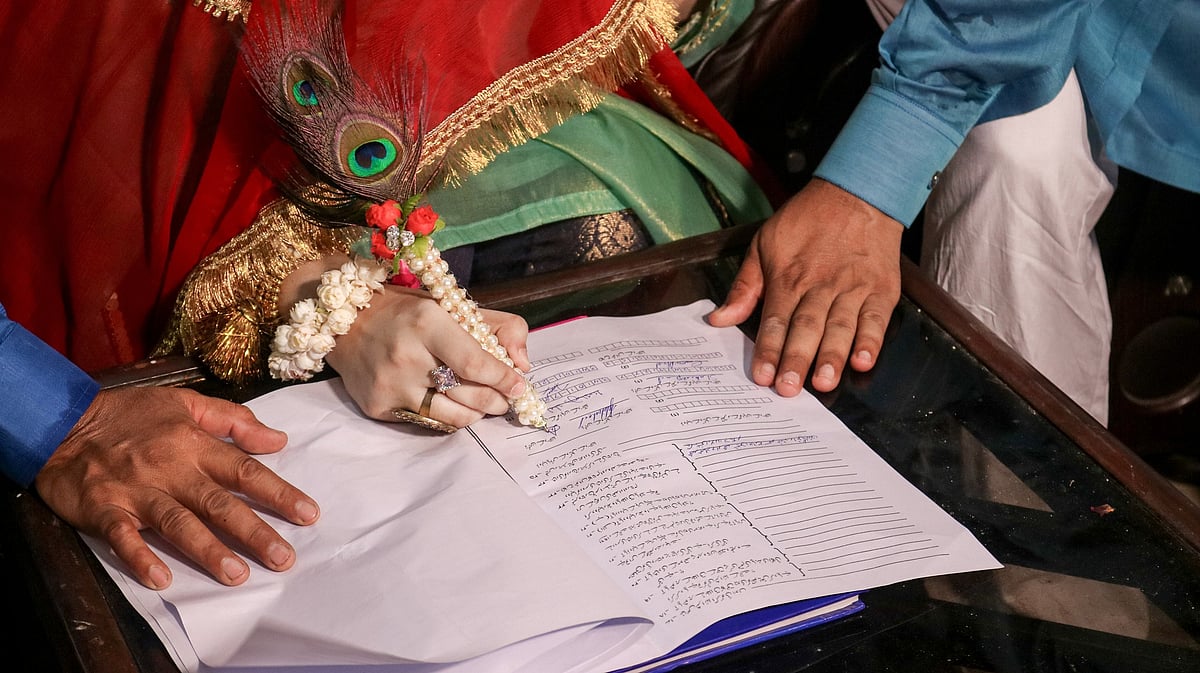
The living room was decorated with roses and marigolds, flowers customary for the mayoun ceremony. Decorated bowls were filled with ubtan mixed with rose water; the paste was to be applied on the groom's face as a pre-wedding tradition. Before the ceremony could start, the groom's father walked into the room with an ashen face.
He had just gotten off the phone with one of the imam (nikah registrars) who was supposed to preside at the nikah ceremony the next day. The imam was upset that the groom had granted the bride the right to divorce in the nikahnama and had also entered a stipulated condition in the contract, as per the wishes of the bride. The imam had chastised the groom's father and accused him of bringing bad luck into the relationship prior to the nikah. When asked if he would still preside over the nikah, he grumbled and said that he would read the nikah although he did not wish to endorse conversations regarding divorce at the time of nikah.
Nearly eight months after writing my master's dissertation titled "Towards Financial Security for Married Muslim Women: Re-evaluating the Nikahnama, Mahr and Jahez in Pakistan," I was watching this dreaded scenario play out right before my eyes at a family wedding. In my dissertation, I had highlighted that maulvis were wrongfully pressuring families to cancel clauses pertaining to financial and social rights of married women in the nikahnama, and encouraged the families of the grooms to remain steadfast in ensuring that the bride was given her due rights. However, I witnessed a family that was fully aware of the nuances of the nikahnama asking their son to cancel the clauses to ensure that the nikah ceremony was 'peaceful,' 'blessed,' and 'auspicious.'
When I said that there was nothing un-Islamic and inauspicious in giving the bride what was her right, I was shut down with glares and barbed comments. It was deja vu as I had encountered similarly icy reactions during interviews for my dissertation. Therefore, nearly eight months after the submission of my dissertation, I decided to revisit my ethnographic research in tandem with my latest experience of attending a family wedding, to examine in minute detail how religion, gender and law come together in this colourful kaleidoscope of the nikah ceremony.