
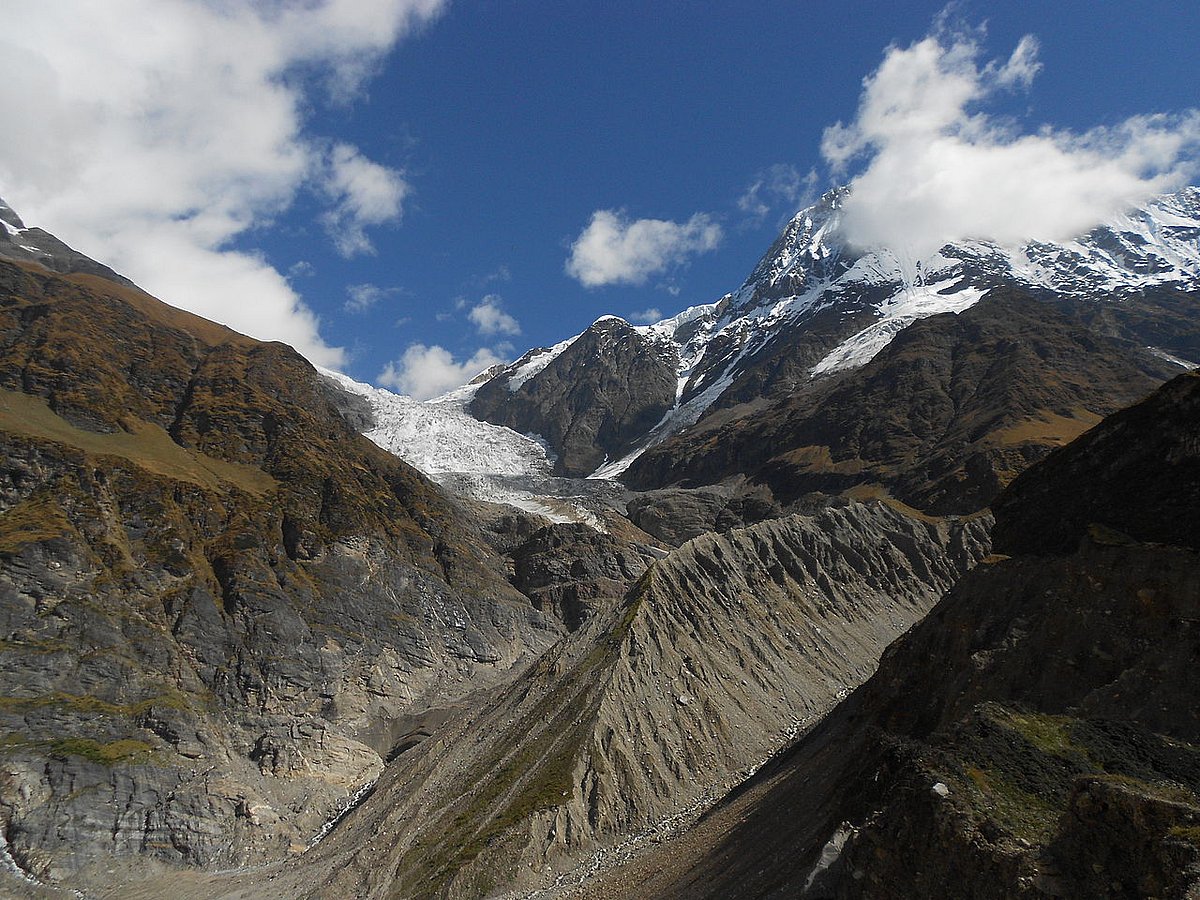
Declared a 'revenue village' by the Uttar Pradesh government in 1960, Gangotri, located 3240 m above sea level, has since scaled up dramatically in order to accommodate those seeking Ganga's blessing. The idol of the deity arrives in May, residing in a temple built by the long-ago Gorkhali general with imperial ambitions, Amar Singh Thapa. After the Diwali festival, the idol is carried down to its winter abode in Mukhba, near Harsil. In recent years, Gangotri has also been encountering new kinds of seekers: the scientist, environmentalist and journalist, making the climb to observe and understand the apparently faster-paced melt of glacial systems, the most obvious sign of a warming of the globe.
As a pilgrim of the latter variety, taking advantage of the easy vehicular access, I arrive in Gangotri in search of a certain swami, well known for his voluminous documentation of glacial melt. I find an ashram by the name of Ishavasyam, in the inner sanctum of which hang framed photographs of ice, snow and rock. This must be it. Over tea, the young Swami Raghavendrananda expounds on global warming, from the unprecedented high temperatures in recent years in Calcutta to the drained deep water aquifers of Punjab. After a fervent monologue on the human sullying of air and water, he bids farewell, with a visiting card and a smile that passes over to his next awaiting guests.
Later, I find another swami with another collection of photographs hanging in his cove. Whether due to his age, his modest hermitage or his temperamental decision not to meet with us for the next five hours, I come to realise that he is actually the original 'Sadhu who clicks', reference to the photographically inclined Sundarananda. He seems to be a crestfallen man after years of internalising the neglect of nature, despite personal success as a photographer and lecturer, with a museum soon to open to showcase his work. He starts right in, warning, "During the late 1800s, the glacier lip was more than nine kilometres downstream in Chirbasa. The ice flow has since receded in length, width and height. In the next 15 to 20 years, the Gangotri glacier won't exist anymore!"
The dramatic impact goes well beyond Gangotri. Swami Sundarananda shows photographs of other glaciers, taken during his own mountaineering expeditions beginning in 1956 that provide status updates of some of the glaciers in the Garhwal region: Yamunotri, gone; Vasuki, gone; Chaturangi, almost gone. Changes have also been observed in the amount of snowfall in the area. During the mid-1960s, at least four feet of snow would fall in one winter day; now the average annual snowfall in Gangotri is little more than six inches. Indeed, the reality of receding glaciers and reduced snowfall is a matter of concern whether you speak to the swami or the glaciologist.