
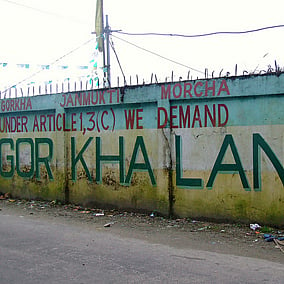
The West Bengal government's response to the Gorkhaland movement follows the same predictable pattern we have seen in Jharkhand, Nagaland, Kashmir and elsewhere. Attempts to resolve ethno-regional conflicts in India have a long history, and have coalesced into a single approach that presupposes the conflicts as being purely political phenomena. It is ironic, then, that the substance of this 'political approach' generally involves the use of punitive measures by state governments to compel contending groups to engage in negotiations. Within this framework, the recurring need is to discipline and punish unruly subjects. Those struggling for Gorkhaland know this well.
The desire for self-governance in the Darjeeling hills is centred on two major claims. The first is the recognition of the collective social and cultural rights that earmark their distinctiveness from the Bengali 'other'. The second is the aspiration to achieve self governance without jeopardising the sovereignty of the nation state. The contours of the Gorkhaland movement, which is over 100 years old, have been defined by the conflation of these positions – the politics of identity on the one hand, and the realisation of this identity through the politics of self-rule on the other. The movement has mobilised issues of 'primordiality' (language, culture, race, shared history, dress) and civility (nationality and citizenship) as important bases of articulation.
A long time coming
A separate administrative system for the Gorkhas of the Darjeeling Hills was first proposed in the early years of the last century, although it was not until the 1980s that the Subhas Ghising-led movement for a separate state reached its violent and vocal apex. In August 1988 the agitators accepted the provision of a Darjeeling Gorkha Hill Council (DGHC), which although falling short of complete autonomy, went some way to devolving power to the hills. Ghising took charge of the new Hill Council and became the figurehead of peace and governance, along with his party men. Outside the Sixth Schedule areas of the Northeast, the DGHC was the first sub-state, local administrative arrangement of its kind in India, and was later used as a post-conflict mechanism to restore normalcy in Ladakh, Jharkhand, and Bodoland. The enthusiasm and hope at the initiation of the Hill Council soon dissipated, however, and the DGHC has since shown itself to be a storehouse of corruption, political high-handedness and nepotism. As Ghising's popularity waned, his authority was challenged by one of his close associates, Bimal Gurung, who founded a new platform, the Gorkha Janamukti Morcha (GJM), in October 2007. Gurung usurped his former political boss in 2008.
With a new leader and political platform, the Gorkhaland movement received a new lease of life. Noticeable in the GJM's approach was a decrease in conflict, and the presence of a peculiar blend of Gandhigiri and non-violence. The possibility of recourse to force was nonetheless implicit. On the whole, the movement remained largely peaceful in its new avatar compared to the struggle of the late 1980s. Still, the daylight killing in May 2010 of All India Gorkha League chief Madan Tamang sent shockwaves through the hills.