
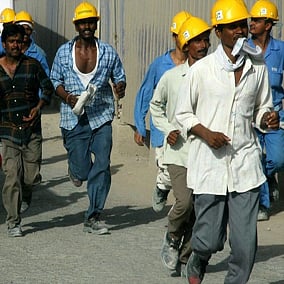
For millions of Indians who travel to the Gulf and other West Asian countries for work, the kafala (sponsor) system is a known devil. As per the system, which operates right across the region, a worker is directly recruited and, subsequently, cared for entirely by his employer. On one hand, this system aids the migration process because once a worker is hired, all his costs for securing visa and other legal documentation, along with his living expenses, like food and accommodation, are paid for. As a result, from the 1960s onwards, there has been steady out-migration of job seekers, skilled, semi-skilled and unskilled, from states like Kerala, Tamil Nadu and Andhra Pradesh and now, from Goa and Uttar Pradesh as well. The spurt in expatriate workers to the Gulf rode the 1973 oil crisis, and rising oil prices. But the kafala system is also riddled with corruption, abusive practices and extreme exploitation because it places the well-being of the worker entirely on the firm or individual employing him, without any proper checks and balances.
As a part of a research project, I was able to visit Jordon, one of the coveted 'modern' destinations for migrants (compared to the ultra-conservative Saudi Arabia). Even though the country on the whole is progressive, when it comes to migrant workers, the kafala system dictates their experiences. For instance, when a worker is recruited, a contract is signed wherein all details of the worker's employment are spelt out. The contract, in keeping with the labour laws, ought to be made available in Arabic, and the native language of the migrant worker. But this seldom happens. Substitution of contracts, wherein the original content of the contract is replaced by other terms and conditions is quite rampant. Since the original contract is often never provided to the workers in a language they understand, there is no way to track such substitutions.
Prakash Rajbar, for instance, was handed over a contract in Arabic, when he was recruited by an agent in Mumbai. On reaching Amman, he got his contract in Hindi (his native tongue). This was when he realised that he had been duped. By then, there was nothing he could do, since he had paid more than INR 80,000 to the agent for a garment cutter's job in Jordan. Contract substitution affects skilled labour too, like Sharon Raj, an engineering diploma holder who was recruited as a supervisor to work with Classic Builders in Jordan. He was contracted to receive JD 587 (USD 830) per month. But since 2014, he has only been paid JD 400 (USD 565) per month till now. The salary cuts were justified on the grounds that he was doing an "unsatisfactory job", although he was working 12 hours every day at the construction site. This was in violation of the Jordanian labour law that specifies that no worker can be made to work more than 48 hours a week, and needs to have a weekly off.
Rajbar and Raj are only two among thousands of such cases. It is not uncommon to see a worker, who has been hired as a driver for example, to be packed off to work on agricultural land or a camel farm. Even highly qualified labour can end up working as domestic helps. This causes many workers to quarrel and fall out with their sponsors, and run away from their workplaces. If this happens, the sponsor refuses to renew the visa, work and residency permits. Thus, the worker ends up becoming an illegal immigrant, liable to pay a fine. At times, since the sponsor may not care to pay workers for months together, when labourers finally do flee, they are often penniless and can't pay any fines. Eventually, they become scapegoats for what was essentially the fault of the employer.