
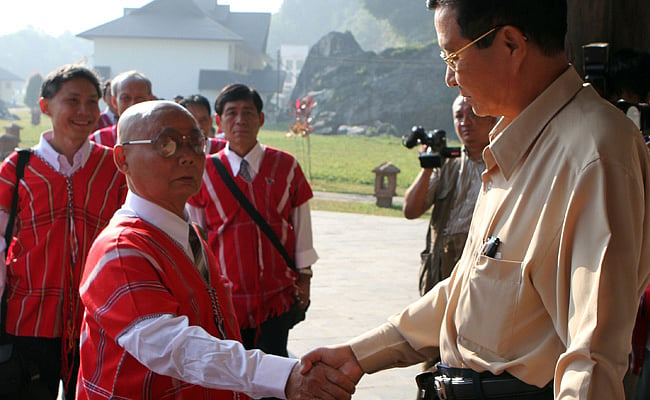
Hopes of an end to the world's longest-running insurgency were raised in recent days, as several ethnic rebel groups entered into ceasefire agreements with the Burmese government. The most important of these took place on 12 January, when the Karen National Union (KNU) signed a truce with government representatives. This is a potentially significant step towards peace, as the KNU has been fighting for independence from the Burmese government for more than six decades. 'This is a historic event, though it is only the first step in a long process,' said David Htaw, one of the leaders of the KNU delegation, who attended the signing ceremony. 'The people have experienced the horrors of war for a long time. I hope they'll soon be able to fully enjoy the sweet taste of peace.'
The next day, the KNU delegation flew to Naypyidaw, where the members met with Vice-President Tin Aung Mying Oo and Defence Minister Major-General Hla Min. 'That was a very emotional meeting,' a member of the Burmese delegation told this writer. Reportedly, bitter decades-long enemies embraced each other.
Signed in the Karen state capital of Pa'an, the truce involves five components. There is an agreement to stop fighting immediately, to warn each other of troop movements so as to avoid future clashes, and for the KNU to set up liaison offices in various Karen towns in eastern Burma. The KNU members will also be allowed unrestricted, unarmed travel within what are known as the special economic zones within Karen state. Finally, there has been agreement to carry out further discussion on the 11 demands put forth by the KNU delegation.
The KNU leaders insist that this is not a ceasefire agreement. Rather, it is a truce – an end to hostilities so that peace talks can continue and trust-building measures can be implemented. As a young Karen refugee living in exile in Thailand told this writer, 'The most important thing is to end the fighting.' Indeed, 60 years of armed struggle has left some 150,000 Karen living in refugee camps in Thailand, and nearly half a million displaced inside Burma. (This refugee requested anonymity, as did several sources in this story.) According to a Thailand-based international aid group, the Thailand Burma Border Consortium (TBBC), nearly 100,000 Karen villagers have been evicted from their houses by the Burmese army since 2002.