
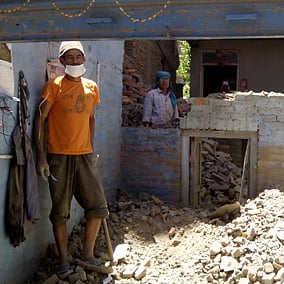
Harisiddhi town is all dust, bricks and stones. The earthquake on 25 April devastated almost all the old brick houses in the area, leaving 23 people dead and 100 injured in the town of over 20,000 inhabitants. As formal and informal institutions around the country ramp up their relief efforts, this old medieval town in Lalitpur illustrates how some areas, especially those located inside the Kathmandu Valley, appear to have transitioned into the second phase of relief efforts, despite the intense scale of destruction.
The town is an example of an area with concentrated relief from several channels – the local Newar community and its extensions throughout Kathmandu, the state in the form of police, private corporate social responsibility relief groups such as Prabhu Insurance, and INGOs such as the Red Cross and Habitat for Humanity. In comparison to Nepal's rural districts, some of which are still waiting for aid and relief, Harisiddhi demonstrates the kind of self-help and reliance on informal and formal networks present within the capital city, which many in affected areas within the Valley have been able to tap into.
While most areas in the country still desperately need temporary sheds or tents, Harisiddhi is well-provided for as people camp under shelter provided by the Nepal Red Cross. Food supply does not appear to be a problem either: there are three centres where food and ration are being distributed. A local store nearby, behind a still-intact temple and amidst the dusty rubble, is still functioning, although new supplies are slow in coming.
With the immediate needs regarding food and shelter taken care of, the inhabitants have moved on to retrieving household items, and opening up the streets blocked by the debris. In a particularly dense area, there are about 20 police personnels, all employed in excavating two ghyampos (large copper vessels) used for storing grains or cooking large quantities of food during ceremonial feasts. A few metres away from this rescue operation is a building. Though the building has suffered heavy damage and appears precarious, three men and one woman are trying to retrieve their belongings from the second floor. A volunteer trying to assist in the effort is annoyed. "Why do they need 20 policemen there," she says, nodding towards the ghyampo rescue operation.