
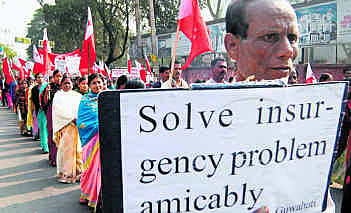
It had seemed that the ULFA wanted the manifesto to be the starting point for talks with the central government, and for the first time a militant outfit was spelling out its political as well as economic positions. While the political positioning seemed ambiguous and the socialism espoused somewhat dated, the manifesto certainly provided the basis for negotiations. The Centre responded positively, committing itself openly to talks. The ULFA formed the People's Consultative Group (PCG) as a think tank to assist it in the parleys.
Problems began immediately, for within weeks came an army crackdown on the ULFA in a wildlife sanctuary in Dibrugarh District. An explosion attributed to the rebels killed several children at Dhemaji on Independence Day, 15 August 2005. There were explosions in Guwahati and elsewhere throughout the following year, all of which were attributed to the ULFA. The latest act was the killing of Biharis in the Tinsukia and Dibrugarh districts in January 2007. The government has invariably attributed the explosions and killings to the ULFA, without producing adequate proof, and with each blast or killing the possibility of negotiations recedes. The killings of Biharis have now pushed back talks indefinitely.
Hawks on Assam
To understand the players in the Assam problem, it needs to be accepted that neither the ULFA nor the government of India is monolithic. Within each, there are both hardliners and those who accept the need for dialogue. While many political figures in the present government in New Delhi seem willing to keep an open mind, one could not say the same about the security forces, nor the apparatchiks within the Ministry of Defence. Additionally, there is a hawkish mindset among those from mainland India who control the economy of the Northeast, including Assam. The ULFA, too, has its hawks, many of them inhabiting Upper Assam, but not exclusively so.
There is a distance in both ideology and the understanding of 'sovereignty' and 'autonomy' between the two sides. The hardliners in the ULFA seem to veer towards independence, while the mainland hawks believe in centralisation, in addition to perceiving the Northeast as a buffer zone to be maintained under the total control of the Centre. There is such a focus on national security and territorial matters that there is no openness to the concept of autonomy. The mainland hawks like to speak of a single Indian culture, which of course reflects the culture of Hindi-speaking India. As one scholar says, Indian-ness is determined by one's Aryan-ness.