
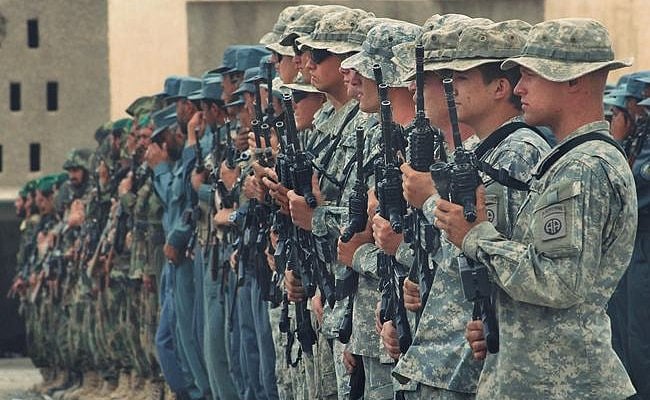
After months of strenuous negotiations and drama, earlier this week Afghanistan and the United States agreed on the draft of the much touted Strategic Partnership Agreement. The Agreement basically states the US will continue to support the war-torn country until 2024. Beyond that unsurprising remark, the agreement scrupulously avoids contentious issues in US-Afghan relations, leaving those for future negotiation. US Ambassador to Kabul Ryan Crocker and Afghan National Security Advisor Rangin Dadfar Spanta initialled the text of the long-term agreement on Sunday.
The agreement must now pass through both countries' processes of internal review. In Afghanistan, it must be approved by the country's National Assembly, which comprises both the upper and the lower house. On Monday afternoon, Spanta and Foreign Minister Zalmai Rassoul briefed Afghanistan's parliament and senate. For the US, it means interagency review, possible consultation with the US Congress (not to be confused with an approval) and a final review by US President Barack Obama.
Officially called the 'Enduring Strategic Partnership Agreement', the pact will broadly outline – but without specifics or concrete commitments – American support for Afghanistan, including military and financial aid, beyond the slated withdrawal of NATO and allied forces in 2014. According to officials, the agreement will also cover social and economic development, security issues, the strengthening of Afghan institutions, good governance and regional cooperation. The agreement is set to expire at the end of 2024, but upon mutual agreement it can be extended in its final six months, or nullified at any time.
All foreign governments and groups involved with the Afghan government would like the agreement to be signed before the NATO Summit in Chicago this May, where the handover of responsibilities to the Afghan government will be high on the agenda. A formal announcement of the agreement could be made at the event, since there is unlikely to be any other noteworthy declaration from the US or its NATO allies.