
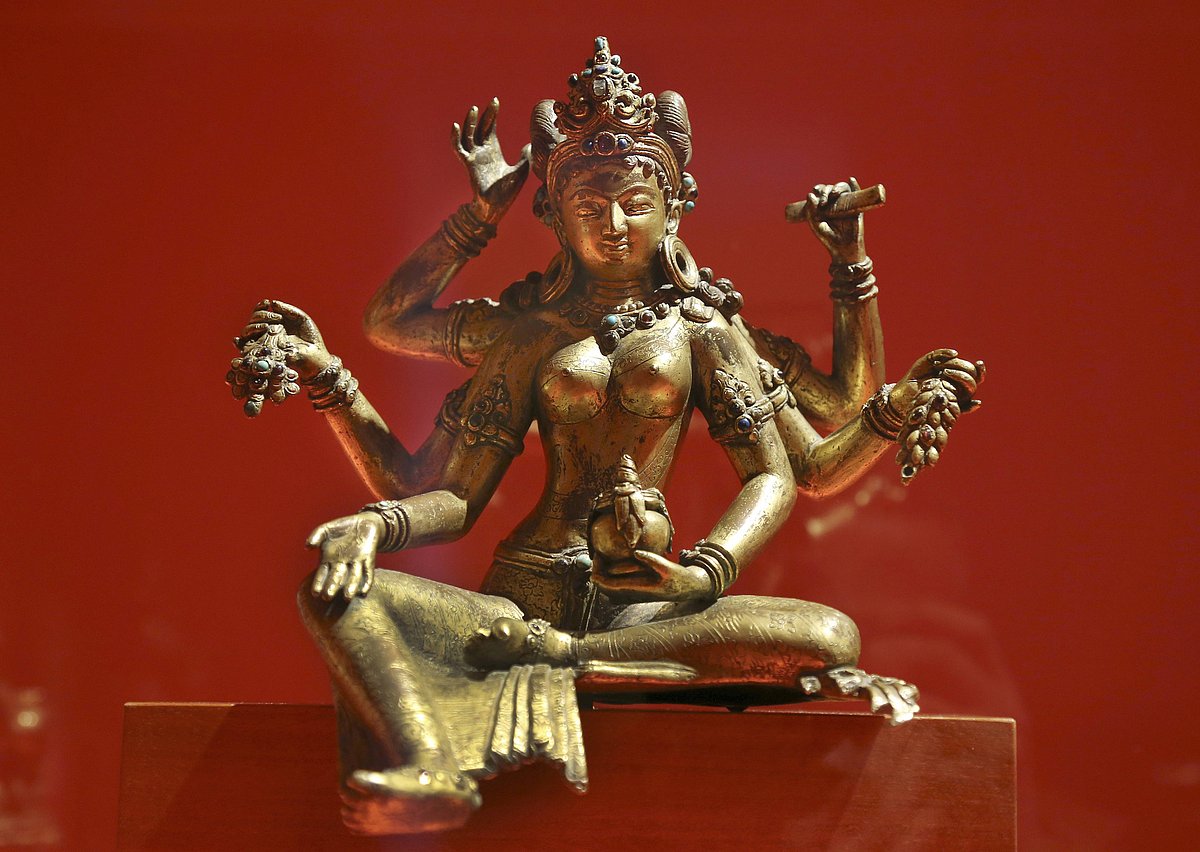
Other people’s secrets are especially interesting. Their content hardly matters. Rather, the draw is the feeling of power that comes from knowing something that someone else did not want us to know. You hold the key, even if you have no interest in going through the door it unlocks. At least, this is how I understand the appeal of Tantric Buddhist and Hindu artefacts to many Western collectors. These artefacts are esoteric: meant to be interpreted one way by most people, but in a very different way by initiates who can read their hidden meanings. For example, you may see a yab-yum image as a merely erotic representation of sexual intercourse unless you know it symbolises the union of action and wisdom necessary to achieve enlightenment.
Once, these interpretations were passed down from teachers to students within religious traditions. Now, they have been revealed by a century of published scholarship. Still, mystery continues to surround the esoteric artefacts of Himalayan cultures. But today, the secrets have to do not with the artefacts themselves, but with those who buy and sell them. In this review, I offer myself as a guide to the hidden meanings of two characteristic publications in the field, one a survey of Himalayan art and the other a catalogue of an American private collection.
Project Himalayan Art is composed of a digital platform, a book titled Himalayan Art in 108 Objects, and a travelling exhibition. The project was launched by the Rubin Museum in New York City, which subsequently announced that it will close its physical space and become a museum without walls, lending its collection of Himalayan art to other institutions.
As Jorrit Britschgi, the Rubin’s executive director, writes in the book’s preface, Project Himalayan Art aims to remedy the “under-representation of Himalayan art” in college curricula, which the organisers believe is “due in large part to the lack of introductory resources for teaching.” Britschgi notes that the decision to structure the project around a limited number of artefacts necessarily “entails omissions”. He hopes that the digital platform will grow to cover more topics, including “contemporary art, cultural activism, colonialism, and issues of provenance.”